
Bleaching gets your hair light. It doesn’t get it the right color. Most people end up with yellow, straw, or orange hair that looks nothing like the icy blonde in their reference photo.
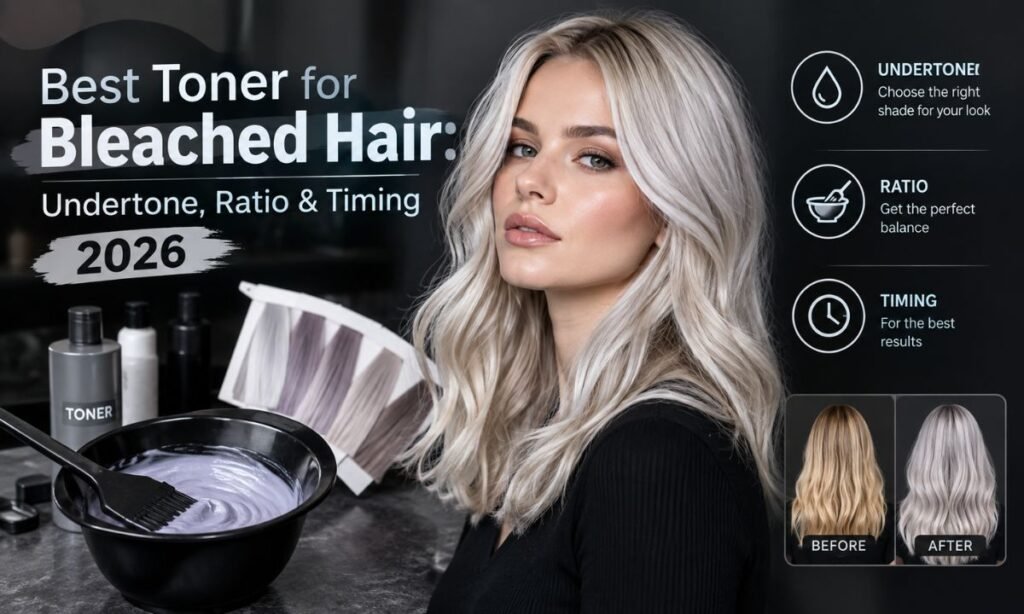
That is where toner comes in. But the best toner for bleached hair isn’t one magic bottle. It depends on three things: the undertone left in your hair, the ratio you mix it at, and the timing you leave it on.
Get those three right and you get clean, even blonde. Get one wrong and you get purple patches, gray dullness, or hair that is still brassy.
This guide covers each of them in plain steps. You’ll learn how to read your hair, pick the right toner family, choose a developer, set your timing, and fix mistakes if they happen.
What Does Toner Actually Do on Bleached Hair?
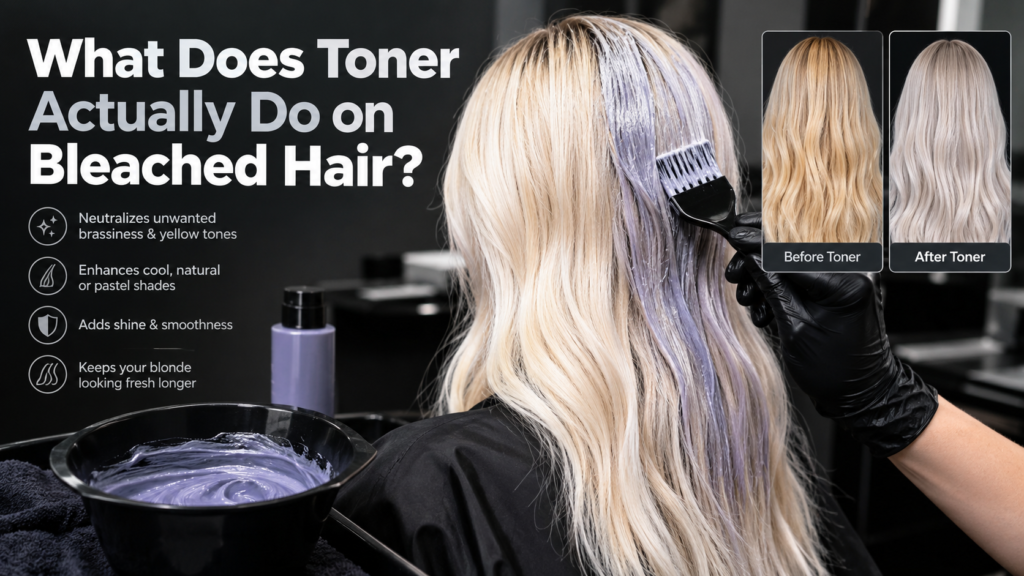
Toner doesn’t lighten your hair in any meaningful way. It adjusts the tone.
Bleach removes natural pigment, but it never removes all of it. What is left over shows as yellow, orange, or gold. Toner deposits a small amount of the opposite color to cancel that leftover warmth. This is basic color wheel logic.
- Blue cancels orange.
- Blue-violet cancels yellow-orange.
- Violet cancels yellow.
Most professional toners are low-level, oxidative or demi-permanent colors. They are mixed with a developer, which opens the cuticle slightly so the pigment can settle into the outer cortex. Purple shampoos are different. They only coat the surface and wash out quickly.
Quick answer: Toner neutralizes unwanted yellow or orange tones in bleached hair by depositing opposite-color pigment. It changes tone, not lightness.
How Do You Read the Underlying Pigment After Bleaching?
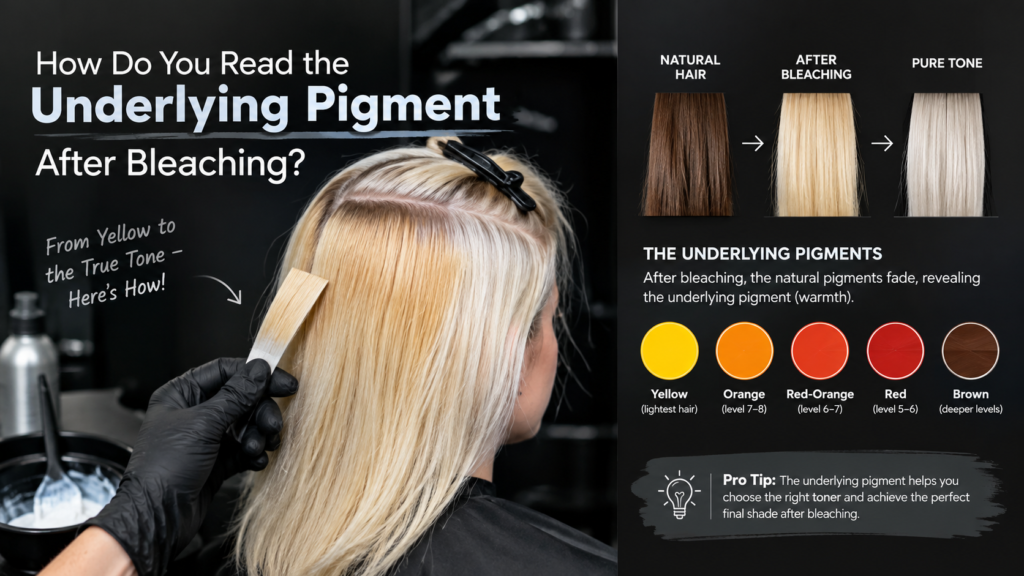
You can’t choose a toner until you know what you’re toning. Look at your hair after rinsing the bleach and drying it, in natural daylight.
Wet hair looks darker and warmer than it really is. A bathroom bulb can fool you completely. Stand near a window instead.
The Lift Level Chart
Hair lightens in stages. Each stage has a typical color. Use this table to match what you see to what you need.
| Lift Level | What the Hair Looks Like | Underlying Pigment | Toner Color Needed |
| Level 6 | Red-orange, copper | Red-orange | Not ready. Lighten more first |
| Level 7 | Bright orange | Orange | Blue (only if you can’t lift further) |
| Level 8 | Yellow-orange, gold | Yellow-orange | Blue-violet / ash |
| Level 9 | Yellow, banana | Yellow | Violet |
| Level 10 | Pale yellow, inside of a banana peel | Pale yellow | Light violet / pearl |
Signs Your Hair Is Ready to Tone
- It looks pale yellow, like the inside of a banana peel.
- The color is even from roots to ends.
- No dark or orange patches remain.
Signs You Should Lighten Again First
- The hair is still orange or deep gold.
- You see uneven bands or hot roots.
Toner is a finishing step. It can’t turn orange hair into platinum. If you tone over orange, you often end up with a muddy, greenish, or dull result.
Check Porosity Too
Bleached hair is porous, but porosity varies across the head. Ends are usually more open than roots.
A simple test: spray a small section with water. If the water beads up, porosity is low. If it soaks in fast, porosity is high. High porosity means the toner will grab quickly and also fade quickly.
How Do You Choose the Right Toner Family Based on Undertone?
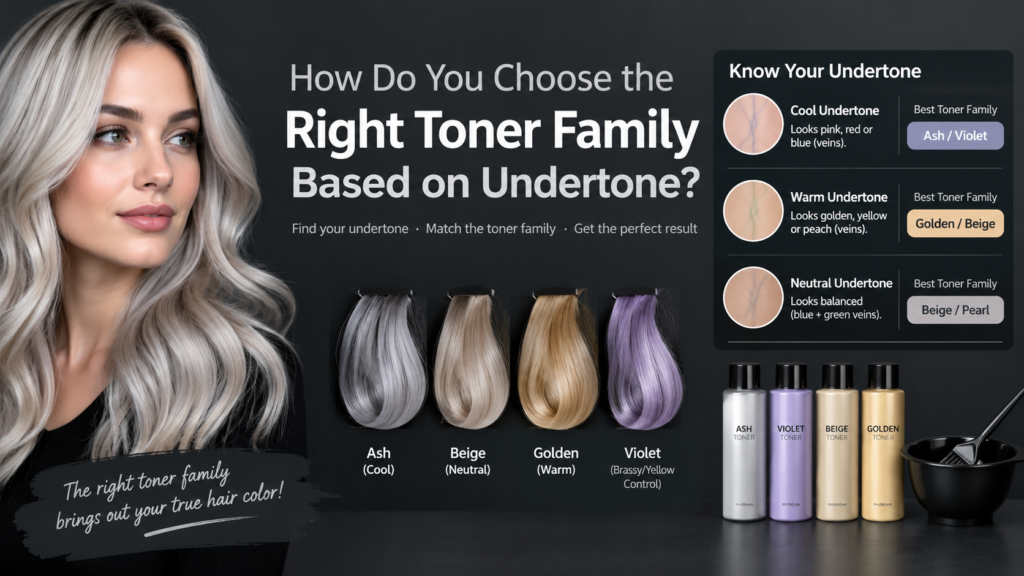
This is the core of how to choose a toner for bleached hair. Pick by the pigment you see, not by the shade name on the box.
What Toner to Use on Bleached Hair, by Undertone
| Your Hair Looks | Best Toner Family | Example Shade Types |
| Pale yellow (level 10) | Violet / lilac / pearl | Lilac, pearl, platinum violet |
| Yellow (level 9) | Violet to violet-ash | Pale ash, violet blonde |
| Yellow-orange (level 8) | Blue-violet / ash | Ash blonde, pale ash |
| Orange (level 7) | Blue / blue-based ash | Blue ash, deep ash |
| Mixed, uneven | Treat in zones | Different toners on roots vs ends |
Which Toner Cancels Yellow Hair After Bleaching?
A violet-based toner does this. Violet sits directly opposite yellow on the color wheel. Look for words like violet, lilac, pearl, or platinum on the label.
Which Toner Cancels Orange Hair After Bleaching?
A blue-based toner does this. Blue sits opposite orange. Look for ash, blue ash, or blue-based neutralizers. Be careful here. A toner can only cancel so much, so very orange hair needs more lift first.
Which Toner Should You Use for Yellow-Orange Hair?
Use a blue-violet or ash toner. It covers both sides of the problem. Many people want one bottle that fixes everything, and this is usually the closest thing.
Common Toner Types in 2026
You don’t need a specific brand, but it helps to know the common types.
| Type | Typical Use | Notes |
| Permanent/lifting toners (e.g., Wella T-series like T18, T14) | Hair at level 9–10, strong neutralizing | Mixed with developer, usually 1:2 |
| Demi-permanent glosses (e.g., Redken Shades EQ type) | Soft tone, shine, lower damage | Usually 1:1 with processing solution |
| Liquid professional toners | Salon use, flexible shades | Follow the brand’s own chart |
| Purple/blue shampoos and masks | Weekly upkeep | Surface-level only, no developer |
| Color-depositing conditioners | Between toning sessions | Gentle, short-term |
Shade numbers differ between brands, so always read the manufacturer’s chart. A “T18” from one line is not the same as an “09V” from another.
See More: 30 Mid Taper Fade Haircuts for Black Men (2026) – Stylish, Clean & Modern
Toner Shade Mistakes to Avoid
- Picking “silver” or “gray” for yellow hair. Gray toners are often too dark and can leave dullness.
- Choosing by the model on the box. Her starting level isn’t yours.
- Mixing brands without testing.
- Buying a stronger shade “to be safe.” Stronger isn’t safer on porous hair.
Which Developer Volume Should You Use When Toning After Bleaching?
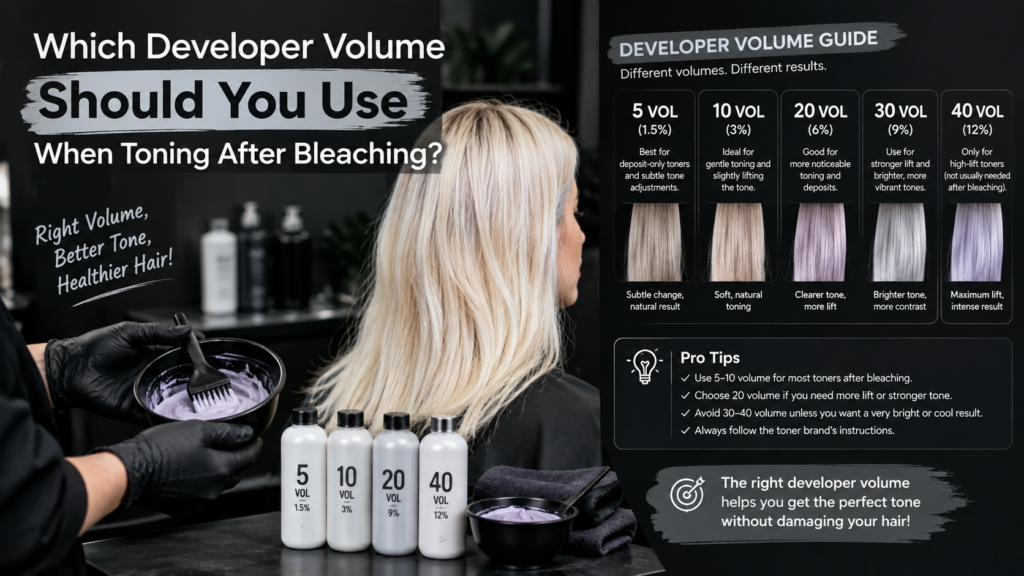
The developer controls how much the toner deposits and how much it lifts. Volume is the strength.
| Developer Volume | Lift | When to Use It |
| 5–6 vol | None | Very fragile hair, soft gloss, minimal change |
| 10 vol | Little to none | Most toning on bleached hair; safest choice |
| 20 vol | Slight | Stubborn yellow, or when the toner label asks for it |
| 30–40 vol | High | Not for toning. Avoid, especially at home |
The Simple Rule
- Fragile, damaged, or very light hair: go with 10 volume.
- Healthy hair with stubborn warmth: 20 volume can help.
- 30 or 40 volume: skip it. Extra lift adds damage and can leave hair uneven, which is the opposite of what you want.
Some toners, such as certain lifting toners, are designed for 20 volumes and the label will say so. Follow the label. When the brand says 10, don’t “boost” it to 20 just to hurry things up.
What Ratio Do You Mix Toner and Developer?
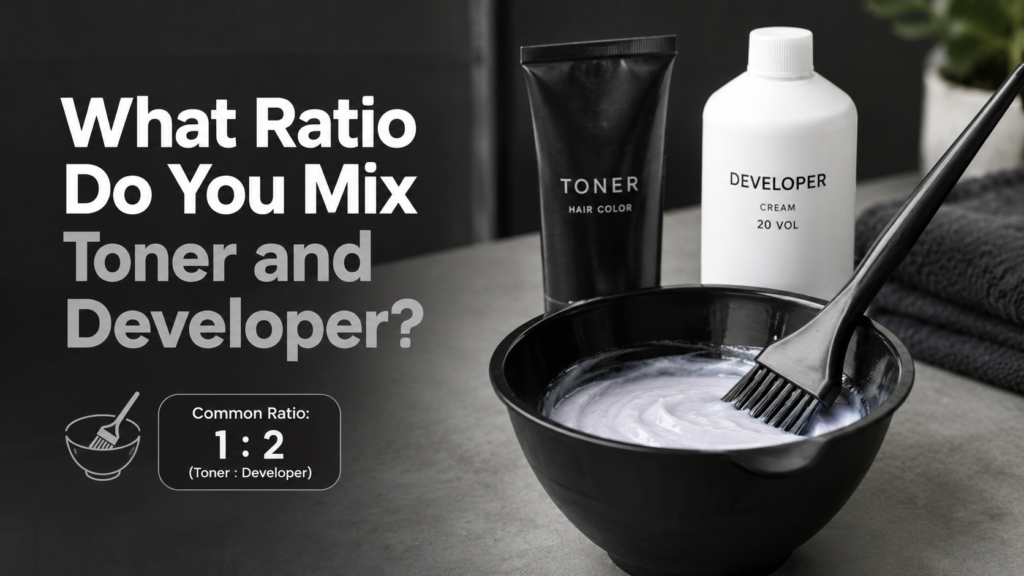
There is no single universal ratio. It depends on the product type.
| Product Type | Common Ratio (Toner : Developer) |
| Lifting/permanent toners (e.g., Wella T-series) | 1 : 2 |
| Demi-permanent glosses | 1 : 1 (with brand’s activator) |
| Liquid toners | 1 : 1 or as listed |
| Pre-mixed/no-developer toners | No mixing |
The two most common are 1:1 and 1:2. For example, 30 ml of toner with 60 ml of 20 volume developer is 1:2.
How to Mix It Properly
- Use a non-metallic bowl and a tint brush.
- Measure with a scale or measuring cup. Don’t eyeball it.
- Mix until smooth and even, with no streaks.
- Apply right away. Don’t let it sit.
Wrong ratios cause patchy results. Too little developer can leave toner weak and uneven. Too much can thin the formula and reduce deposit.
Quick answer: Most lifting toners mix 1 part toner to 2 parts developer. Most demi-permanent glosses mix 1:1. Always check the label.
How Long Should Toner Process Based on Porosity?
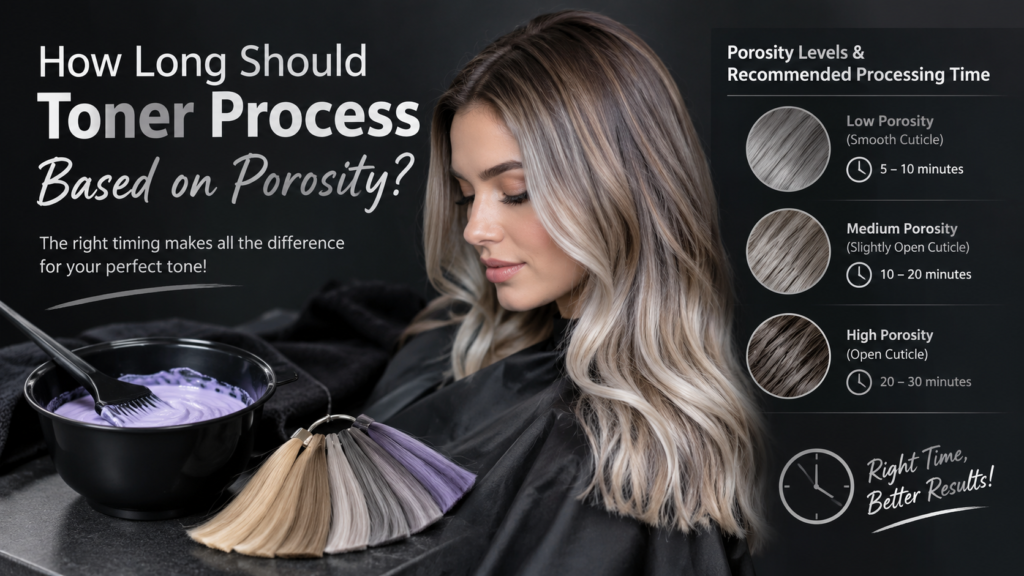
This is the part most people get wrong. Timing isn’t fixed. It changes with how open your hair is.
How Long to Leave Toner on Bleached Hair
| Hair Condition | Typical Processing Time |
| Very porous, damaged | 5–10 minutes (check often) |
| Medium porosity, healthy bleach | 10–20 minutes |
| Low porosity, resistant | 20–30 minutes |
| Per product label | Always the upper limit |
Many lifting toners suggest up to 30 to 45 minutes on the box. But bleached hair often tones much faster. Start watching at 5 minutes.
How to Check Progress
- Wipe a small strand with a damp paper towel.
- Look at the color against white.
- Is the yellow gone? If yes, rinse.
- If not, wait 3 to 5 minutes and check again.
This is called a strand test. It takes under a minute and prevents most disasters.
Why Over-Processing Is a Problem
Leave the toner on too long and it deposits too much. The result is purple, silver-gray, or even blue tones. This is especially true on very porous ends.
Under-processing is less risky but frustrating. The yellow stays and you waste product.
Can You Tone Hair Immediately After Bleaching?
Yes. In fact, many professionals do exactly that. After you rinse out the bleach, the cuticle is open and the hair is ready to accept color. Toning at this stage is efficient and often gives better results.
A few things to remember:
- Rinse well and shampoo with a gentle, sulfate-free shampoo.
- Towel dry until damp, not dripping.
- Check your level. If the hair is still orange, bleach again first. Don’t tone over it.
Some people prefer to wait 24 to 48 hours if their scalp feels sensitive or the hair feels very fragile. That is a valid choice. Just know that waiting slightly changes how the toner absorbs.
How Do You Tone Bleached Hair Step by Step?
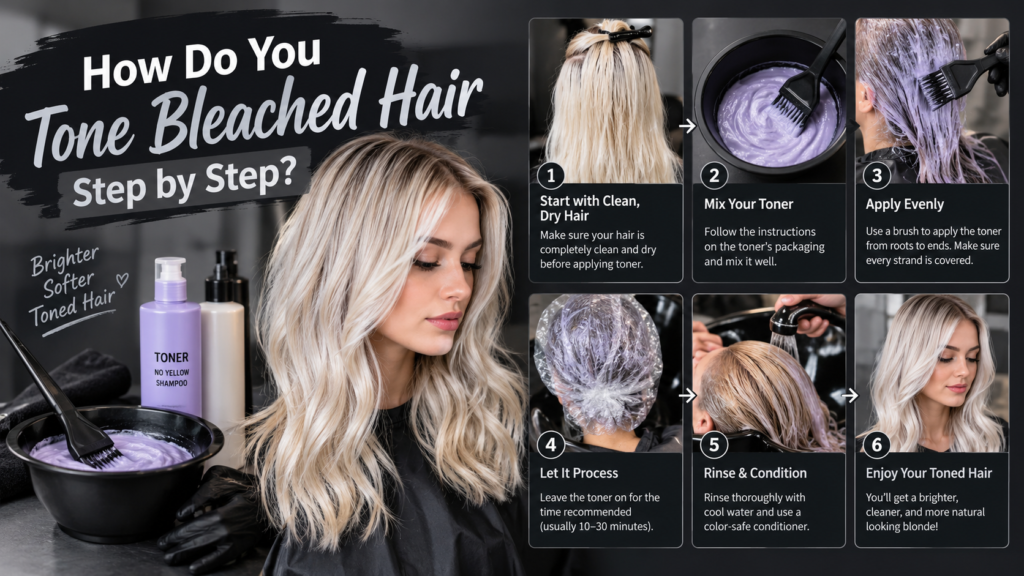
Here’s the full process, from setup to rinse.
What You Need
- Toner of the right family
- Correct developer (usually 10 or 20 volume)
- Non-metal bowl and tint brush
- Gloves and an old towel
- Clips, timer, and a strand-test cloth
- Gentle shampoo, plus deep conditioner
Steps
- Do a patch and strand test. Test a small hidden section first. Check for skin reaction and color result.
- Prep the hair. Shampoo gently after bleaching, then towel dry. Hair should be damp.
- Section into four parts. Clip them up for clean, even coverage.
- Measure and mix. Use your brand’s ratio (often 1:2 or 1:1).
- Apply to the yellowest areas first. Usually the mid-lengths. Then do roots and ends. Roots process faster from scalp heat, so they go on last.
- Saturate evenly. Work product through with your fingers or brush so no spots are missed.
- Start the timer and check early. Look at 5 minutes, then every few minutes.
- Rinse with cool or lukewarm water. Rinse until the water runs clear.
- Condition. Use a deep conditioner or bond-repair mask.
- Style as usual. Check the result in natural light.
Bleached Hair Before and After Toner
Here’s what typically changes.
| Before Toner | After Toner | |
| Color | Yellow, brassy, straw-like | Cool, clean, even blonde |
| Shine | Dull | Brighter, glossier |
| Tone | Warm, uneven | Balanced, neutral |
| Overall feel | Raw | Finished |
A good result looks like soft cream, beige, pearl, or silvery blonde depending on your goal. It shouldn’t look flat gray or lavender unless you chose that look.
Can Toner Fix Orange Hair Without Bleaching Again?
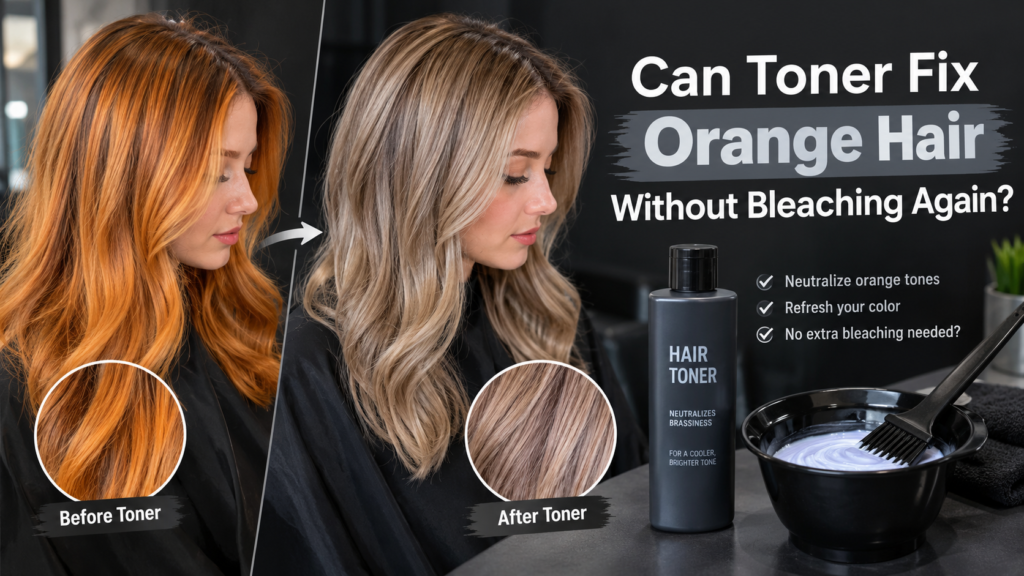
Sometimes, but only partly.
If your hair is light orange or yellow-orange, a blue-based toner can improve it a lot. If it is deep orange or red-orange, toner alone usually can’t fix it. There is too much warm pigment and not enough room to cancel it.
What happens if you try anyway:
- The toner may turn muddy or greenish.
- The color may look dull and flat.
- The orange often returns after a few washes.
For deep orange, lighten gently again, then tone. If hair is already damaged, wait and rebuild it first with bond-repair care.
What Are the Most Common Mistakes When Toning Bleached Hair?
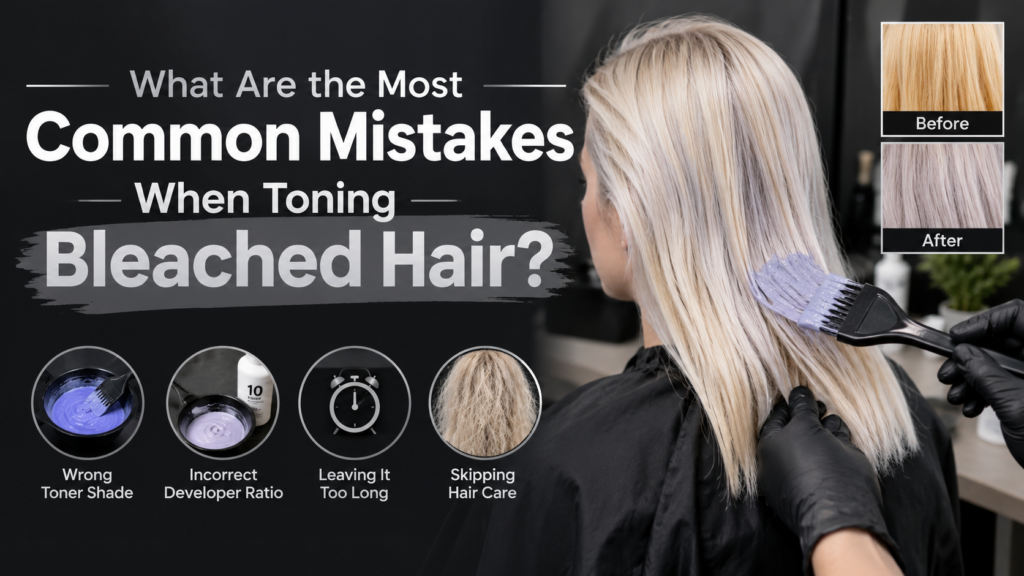
Avoid these, and your results improve right away.
- Toning too early. Hair that isn’t pale yellow won’t tone cleanly.
- Picking the wrong color family. Violet on orange does very little. Blue on pale yellow is overkill.
- Using high-volume developers. 30 or 40 volume adds damage with no benefit.
- Skipping the strand test. It’s the cheapest insurance you can get.
- Guessing the ratio. Measure it.
- Leaving it on “just to be safe.” More time isn’t a better time.
- Applying to dry, dirty hair. Product grabs unevenly.
- Ignoring the ends. Porous ends can turn gray or purple while the roots stay warm.
- Overusing purple shampoo. It builds up and leaves dull, lilac-tinted hair.
- Skipping aftercare. Bleached hair needs moisture and bond support.
What Do You Do When the Toner Goes Wrong?
Don’t panic. Most toner mistakes are fixable.
If the Hair Turned Purple or Lavender
- Wash with a clarifying shampoo two or three times.
- Leave suds on for a few minutes.
- It should fade in a few washes.
If the Hair Turned Gray or Dull
- You likely over-processed or used too ashy a shade.
- Clarify, then use a warm gloss or a gentle golden toner to restore balance.
If the Hair Is Still Yellow
- The toner was too weak, applied unevenly, or rinsed too early.
- Wait a day or two. Then retone with the correct violet shade and strand test again.
If the Hair Is Patchy
- Retone only the uneven areas.
- Work in small sections.
- Don’t re-saturate the entire head.
If the Hair Looks Green
- This comes from blue or ash over yellow hair that has no red base.
- A soft warm or rose-toned gloss can balance it. Test first.
When in doubt, a stylist can correct it faster than repeated guesswork, especially if the hair feels fragile.
How Often Can You Tone Bleached Hair?
A good rule is every 4 to 8 weeks. Between sessions, use maintenance products, not another full toner.
Toning too often stacks chemicals on already stressed hair. Even gentle formulas add up.
Between-Toning Care Tips
- Use a purple or blue shampoo once a week.
- Wash with cool water.
- Choose sulfate-free shampoo.
- Use heat protection every time.
- Add a bond-repair treatment once a week.
- Wear a hat or UV protection outdoors. The sun fades toner fast.
- Rinse after chlorine or salt water.
Quick Reference: Undertone, Toner, Ratio & Timing
Save this table. It pulls the whole guide into one view.
| Underlying Pigment | Toner Family | Developer | Typical Ratio | Check Time |
| Pale yellow | Light violet / pearl | 10 vol | 1:1 or 1:2 | 5–15 min |
| Yellow | Violet / pale ash | 10–20 vol | 1:2 | 10–20 min |
| Yellow-orange | Blue-violet / ash | 20 vol | 1:2 | 10–25 min |
| Orange | Blue-based ash | 20 vol | 1:2 | Strand test often |
Remember: the product label always wins over any general chart.
Frequently Asked Questions
What is the best toner for bleached hair?
The best toner is the one that matches your leftover pigment: violet for yellow, blue-violet for yellow-orange, and blue for orange. Pick the family first, then the brand.
What toner cancels yellow hair after bleaching?
A violet-based toner (look for violet, lilac, or pearl) cancels yellow because violet sits opposite yellow on the color wheel.
What toner cancels orange hair after bleaching?
A blue-based or deep ash toner cancels orange. For deep oranges, lighten the hair further first for a clean result.
What toner should I use for yellow-orange hair?
Use a blue-violet or ash toner. It neutralizes both the yellow and the orange at the same time.
What ratio do you mix toner and developer?
Most lifting toners mix 1:2 (toner to developer), while many demi-permanent glosses mix 1:1. Always follow your product’s label.
What volume developer should I use with toner after bleaching?
Use 10 volume for most bleached hair, or 20 volume if the toner requires it or the warmth is stubborn. Avoid 30 and 40 volume.
How long should I leave toner on bleached hair?
Usually 10 to 20 minutes, but start checking at 5 minutes. Porous hair can tone in as little as 5 to 10 minutes.
Can you tone hair immediately after bleaching?
Yes. Hair is open and receptive right after bleaching, so toning at that point works well as long as the hair has reached pale yellow.
Can toner fix orange hair without bleaching again?
Only light orange or yellow-orange. Deep orange usually needs more lift before toner can work properly.
Why did my toner turn my bleached hair purple or gray?
Over-processing, a too-strong shade, or very porous hair causes it. Clarifying shampoo usually fades the color in a few washes.
How often can you tone bleached hair?
Every 4 to 8 weeks is a safe range. Use purple shampoo between sessions instead of toning again.
Conclusion
The best toner for bleached hair is the one that matches your undertone. Read your pigment first, in daylight. Choose violet for yellow, blue-violet for yellow-orange, and blue for orange.Then keep the technical side simple. Use 10 or 20 volume developers. Mix at the ratio your product asks for, usually 1:1 or 1:2. Watch the clock, and stand the test as you go.
If something does go wrong, it’s rarely permanent. Most purple, gray, or patchy results can be corrected within a few washes or one careful retone.Treat your bleached hair gently. Tone only when needed, hydrate often, and protect your color. That’s how you keep a clean, bright blonde looking good well beyond salon day.





1 thought on “Best Toner for Bleached Hair: Undertone, Ratio & Timing 2026”