
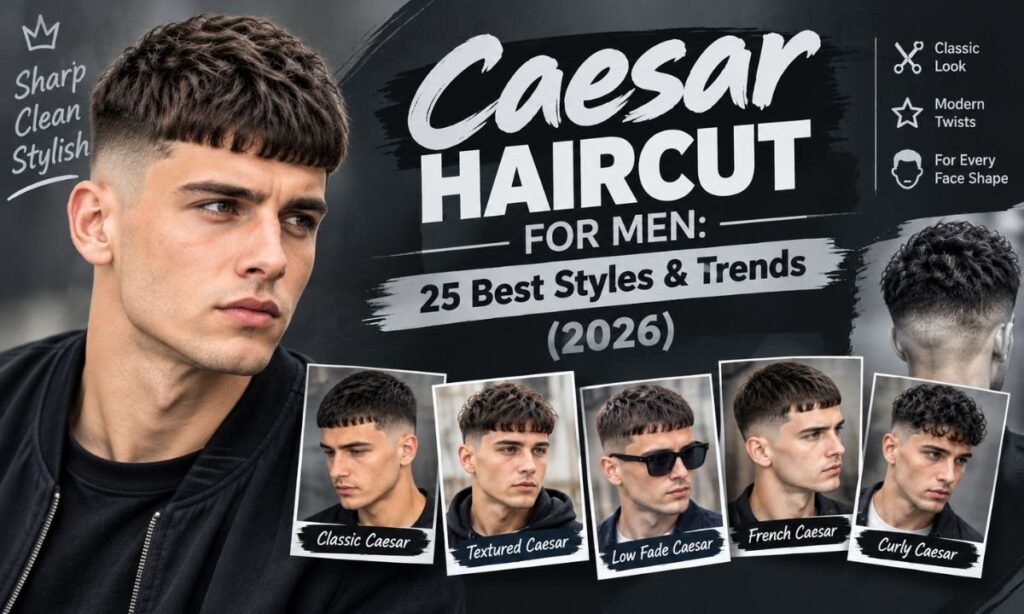
Few men’s haircuts are as easy to live with as the Caesar. The sides and back stay trim, the top stays short, and a neat fringe falls forward over the forehead. It looks put together without asking much from you, which is why barbers still cut it every single day.
Below you’ll find 25 Caesar ideas for 2026, a look at how each fade changes the result, tips for matching the cut to your hair, and a ready-made script to read out to your barber.
Caesar Cut Meaning: A Simple Explanation
The Caesar is a short cut where the hair on top is brushed toward the front and trimmed into a flat, horizontal fringe. The sides and back are kept close and clean. The fringe usually ends around the middle of the forehead or just over the brows.
Quick facts:
- Top hair is kept short and even, commonly 1 to 2 inches
- The fringe points forward, not up or back
- The sides can be tapered, faded, or clipped to one length
- Very little daily styling is needed
The name comes from Roman emperor Julius Caesar. Popular history says he brushed his hair toward his forehead to cover a receding front. The story may be embellished, but the practical idea still holds up two thousand years later.
Why Men Are Choosing the Caesar Again in 2026
Barbers report that clients want cuts that are neat but not high-effort. The Caesar delivers on that for several reasons:
- Fast routine. A quick dab of product and you’re out the door.
- Smart camouflage. The fringe covers a large forehead or a thinning front.
- Flexible edges. It looks good with a soft taper or a sharp fade.
- Natural finish. Dry, matte styling has replaced wet, shiny gel looks.
- Wide compatibility. It works on straight, wavy, curly, fine, and thick hair.
The main 2026 updates are airier, broken-up fringes, gentle tapers rather than aggressive skin fades, and slightly longer tops that still sweep forward.
Traditional Caesar vs Updated Caesar
Both versions come from the same idea. They differ mainly in finish and detail.
| Feature | Traditional Caesar | Updated Caesar |
|---|---|---|
| Top length | Uniform, around 1 inch | Layered, 1 to 3 inches |
| Fringe | Flat and straight across | Broken-up, textured, or slightly slanted |
| Sides | Scissor taper or one-length clipper cut | Taper, or low, mid, and skin fades |
| Finish | Tidy and combed | Dry, matte, a little tousled |
| Products | Water or a light comb-through | Clay, paste, or salt spray |
Choose traditional for a polished, conservative look. Choose updated if you want a cut with more character.
Textured Caesar Cut: The Crowd Favorite
This is the version most men are asking for. Instead of one solid line, the barber snips into the ends of the top hair with scissors or a razor so the fringe looks lighter and less rigid.
What you gain:
- Visible movement on straight, flat hair
- A thicker appearance for fine strands
- Forgiveness as the cut grows out
- A good look even on lazy styling days
To style it, warm a small amount of matte clay in your hands, run it through dry hair, and press the front section forward with your fingertips.
See More: Honey and Chia Hair Mask for Dry Hair: Benefits (2026)
Short Caesar Cut vs Long Caesar Cut
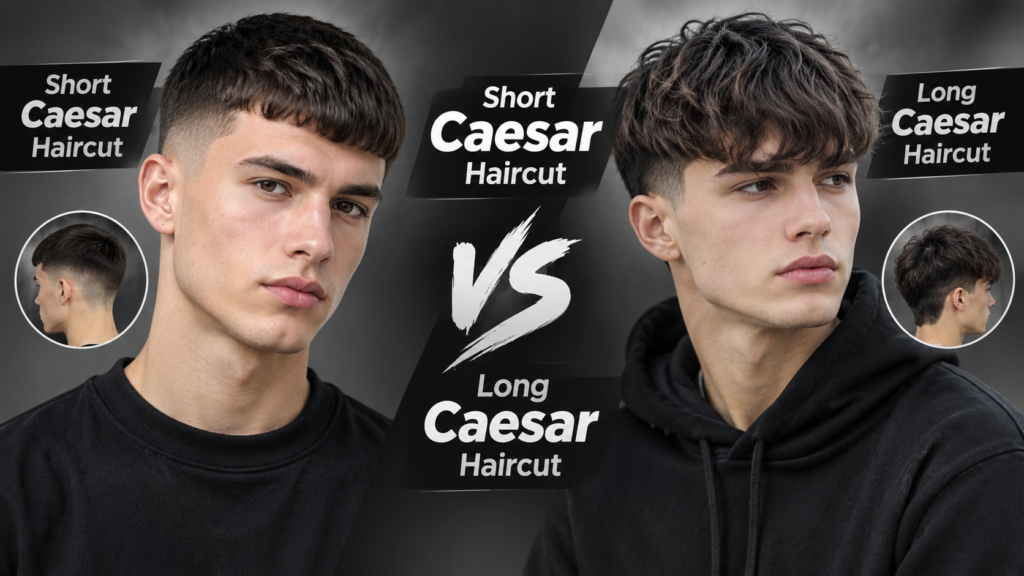
Changing the length changes the personality of the whole haircut.
Short Caesar Cut
With roughly an inch on top, this version sits close to a crew cut but keeps its forward fringe.
- Ideal for active men and quick mornings
- Needs a tidy-up about every 3 weeks to stay crisp
- Suits thick, straight hair best
Long Caesar Cut
Here the top is left at 2 to 3 inches, so the fringe falls in a softer, more relaxed line.
- Gives weight to wavy or dense hair
- Can be styled forward, to the side, or slightly up
- Takes a bit more product and time
| Short Caesar | Long Caesar | |
|---|---|---|
| Top length | About 1 inch | 2 to 3 inches |
| Daily styling | Under a minute | A few minutes |
| Barber visits | Every 3 to 4 weeks | Every 5 to 6 weeks |
| Works best on | Straight, thick hair | Wavy, thick, or curly hair |
Caesar Cut With a Fade: What’s Different?
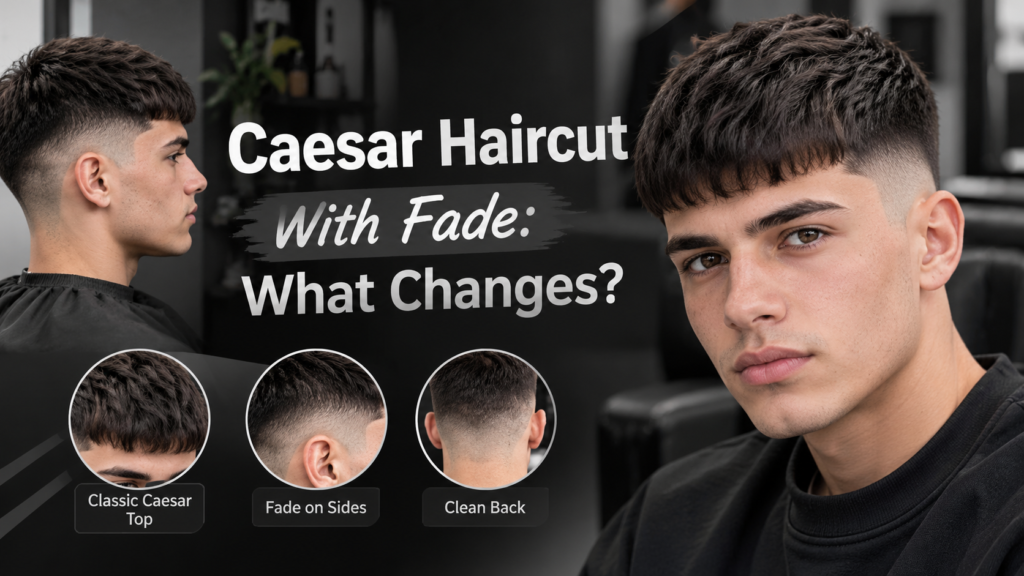
Adding a fade replaces the plain taper on the sides with a smooth gradient that runs from very short (or bare skin) up into the longer top. The result looks cleaner and has more contrast. The fade height is the only major variable.
Low Fade Caesar Style
The blend starts just above the ear and wraps toward the neck. It’s discreet and suits conservative workplaces. Pick this if fades are new to you.
Mid Fade Caesar Style
The blend starts near the temple. It strikes a balance between neat and edgy, and it flatters most head shapes, so it’s the most commonly requested height.
Skin Fade Caesar Style
Also called a bald fade, this one drops all the way to bare skin. It creates the sharpest contrast with the fringe but loses its crispness fast, so plan on going back every two weeks or so.
| Fade | Where It Begins | Look | Upkeep |
|---|---|---|---|
| Low | Just above the ear | Subtle and clean | Every 3 to 4 weeks |
| Mid | Around the temple | Balanced, current | Every 2 to 3 weeks |
| Skin | Bare skin | Bold and sharp | Every 2 weeks |
Searches such as “cesar fade haircut” or “Caesar with fade” all point to this same cut. Only the spelling changes.
Caesar Taper vs Caesar Without a Fade
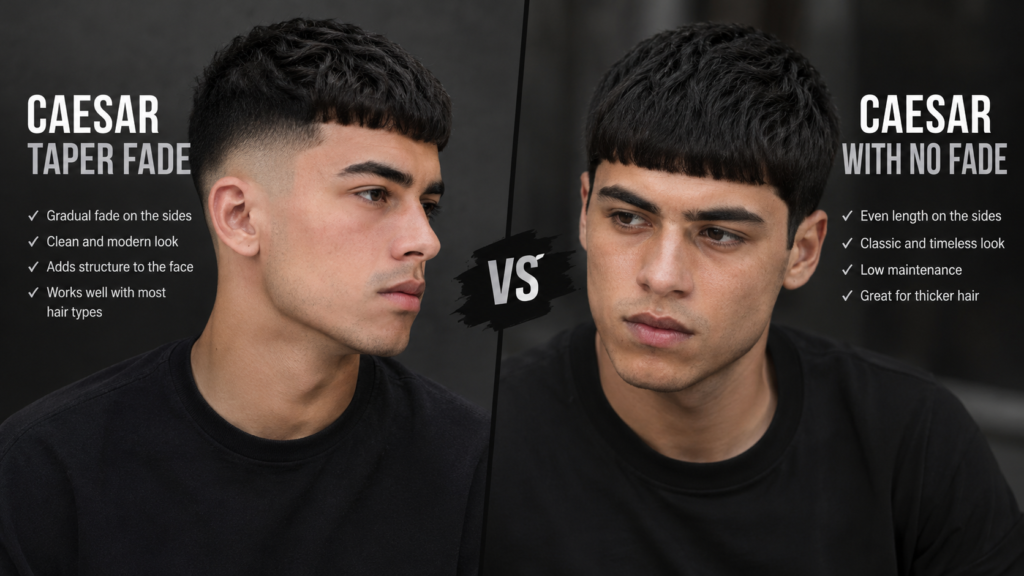
If a fade feels like too much, there are two lower-key paths.
Caesar Without a Fade
The sides and back stay at a single length, with no visible gradient. Growth is even, so it never looks messy between appointments. This suits men who prefer to visit the barber less often.
Caesar Taper
Only the sideburns and neckline get shorter. The rest keeps a little more length. It looks gentler than a fade and sits comfortably between the two options.
| No Fade | Taper | |
|---|---|---|
| Look | Classic and even | Neat and understated |
| Grow-out | Very smooth | Fairly smooth |
| Ideal for | First-timers, busy schedules | Office and daily wear |
Caesar Cut for a Receding Hairline
This is the situation the haircut was practically designed for. The forward fringe sits over the temples and the front edge, so the hairline is hardly noticeable.
How to get the best result:
- Leave the fringe a touch longer than feels necessary
- Request a broken-up edge instead of a hard straight line, which can highlight thin spots
- Go for a taper or low fade; a skin fade can make recession more visible
- Pick a light, matte product rather than shiny gel
If the crown is thinning as well, keep the top short overall. Short hair makes sparse areas harder to spot than longer strands that part and separate.
Caesar Cut for Curly and Wavy Hair
Natural texture does a lot of the work, so only small tweaks are needed.
- Wavy hair: Around 2 inches on top lets the waves add movement to the fringe with minimal product.
- Curly hair: Leave 2 to 3 inches so the curls have room to coil. A very short fringe on tight curls can turn into a boxy puff.
- Coily hair: Keep the top short and the lineup sharp. See the dark Caesar section below.
Apply a curl cream or leave-in conditioner to damp hair, then air-dry or use a diffuser on low heat.
Asian Hair Caesar Cut Ideas
Straight, dense, strong strands hold the Caesar’s shape extremely well. Three popular versions:
- Blunt Caesar with a mid fade: Crisp and formal
- Textured Caesar with a side-swept fringe: A softer, Korean-inspired look
- Long Caesar with a taper: A fuller top that falls forward naturally
Because thick straight hair tends to stick out, ask your barber to thin the top slightly so the fringe lies flat.
Dark Caesar Cut Explained
The dark Caesar is tailored to tightly coiled, natural hair. The top is cut very short and often shaped with a defined edge, while the sides get a taper or fade.
Why it’s popular:
- Sharp, clean edges
- Works nicely with wave patterns and a brushed finish
- Simple upkeep with a soft brush and light moisturizer
The dark Caesar taper is a favorite because it looks refined without being extreme.
Caesar vs Crew Cut: Key Differences
These two are often confused, but they’re not the same.
| Caesar | Crew Cut | |
|---|---|---|
| Direction | Forward | Up and back (or forward) |
| Fringe | Clear, horizontal | Barely any |
| Top length | Even, 1 to 3 inches | Graduated, longest at the front |
| Overall feel | Soft yet structured | Athletic, military-inspired |
Choose the Caesar if you like a defined fringe. Choose a crew cut if you prefer a clear forehead.
Who Should Skip the Caesar?
The cut is flexible, but it isn’t perfect for everyone.
- Men with a strong cowlick at the front hairline may fight the fringe every morning
- Very sparse fronts may need a different approach, such as a short textured crop
- If you want a long, flowing look, the Caesar will feel too restrictive
A good barber can often work around these issues, so mention them before the clippers come out.
25 Top Caesar Haircut Ideas for Men in 2026
Clean and Classic
- Original Caesar: Even top, straight fringe, no fade.
- Cropped Caesar: Ultra-short top that borders on a crew cut.
- Side-parted Caesar: Fringe nudged to one side for a smarter finish.
- Ivy League Caesar: Slightly longer top, combed neat, tapered sides.
- Low-taper Caesar: The softest, most workplace-friendly pick.
Fade Versions
- Low fade Caesar: Gentle blend above the ears.
- Mid fade Caesar: The dependable middle ground.
- High fade Caesar: Strong contrast for a statement look.
- Skin fade Caesar: Bare-skin finish for maximum sharpness.
- Temple fade Caesar: Blend concentrated around the sideburns and temples.
- Drop fade Caesar: Fade arcs down behind the ear.
- Burst fade Caesar: Rounded fade around the ear, great with longer tops.
Textured and Tousled
- Textured Caesar: Point-cut top with a dry finish.
- Tousled Caesar: Relaxed, slightly untidy fringe.
- Choppy Caesar: Razor-cut ends for extra movement.
- Spiked Caesar: Short fringe lifted a little with clay.
Longer and Fuller
- Long Caesar: 2 to 3 inches with a soft, drooping fringe.
- Dense Caesar: Keeps volume for men with thick hair.
- Undercut Caesar: Very short sides with a visible break from the top.
Matched to Hair Type
- Wavy Caesar: Follows the natural bends.
- Curly Caesar: Longer top, defined curls, clean fade.
- Dark Caesar taper: Short and sharp for coily hair.
- Asian Caesar: Blunt fringe on thick, straight hair.
Extra Details
- Caesar with a shaved line: A small razor part or line for added detail.
- Caesar with a beard blend: Fade flows straight into a trimmed beard.
Best Caesar Cut for Your Face Shape
| Face Shape | Recommended Style | Reason |
|---|---|---|
| Oval | Nearly any version | Even proportions suit everything |
| Round | Mid or high fade, textured top | Creates height and defines the profile |
| Square | Low taper, soft fringe | Eases a strong jaw |
| Oblong | Short Caesar, blunt fringe | Makes the face look less long |
| Heart | Longer, textured Caesar | Balances a narrow chin |
What to Tell Your Barber (Word-for-Word)

A reference photo is the best tool you have. To back it up, you can say:
“I’d like a Caesar with a mid fade. Leave about 1.5 inches on top, texture the ends so it isn’t a hard line, and keep the fringe just over my eyebrows. Please finish with a natural neckline.”
Before you go, decide on:
- Fade height: low, mid, or skin
- Top length in inches
- Blunt or textured fringe
- How much time you’ll spend styling each day
- A photo to show
Styling Your Caesar Cut at Home
- Wash and towel-dry until the hair is just damp.
- Work a small amount of matte clay, paste, or salt spray through it.
- Use a comb and a hairdryer to guide the fringe forward.
- Rough up the top with your fingers for texture.
- Dab a tiny bit of product on the tips to hold the fringe.
| Hair Type | Product to Use |
|---|---|
| Fine or thin | Sea salt spray with a little texture powder |
| Thick and straight | Matte clay or paste |
| Wavy | Styling cream or light pomade |
| Curly or coily | Curl cream or leave-in conditioner |
Common Mistakes to Avoid
- Too much product. Heavy layers weigh down the fringe and make it look greasy.
- Skipping the trim. A fringe that grows into your eyes ruins the shape.
- Wrong fade for the hairline. A skin fade can expose a thinning front.
- Brushing the wrong way. Always direct the fringe forward, not back.
Keeping Your Caesar Cut Fresh
- Regular trims: Book every 2 to 4 weeks depending on the fade.
- Gentle washing: Shampoo two or three times a week to protect your scalp.
- Light products: Avoid thick gels that make the fringe stiff.
- Neckline tidy-ups: A quick clean-up between visits preserves the shape.
Frequently Asked Questions
What is a Caesar haircut?
A short cut with a forward-brushed, horizontal fringe and close-cropped sides and back.
Is the Caesar cut still trending in 2026?
Yes. Textured tops with tapers or mid fades are especially in demand.
How is a Caesar different from a crew cut?
The Caesar has a clear fringe falling forward, while a crew cut is normally styled up or back with hardly any fringe.
Is a Caesar good for a receding hairline?
Yes. The fringe naturally covers the temples and front edge.
Can curly hair have a Caesar cut?
Yes, as long as the top is left around 2 to 3 inches so the curls can form.
What is a mid fade Caesar?
A Caesar with a fade that begins near the temple, combining a tidy look with a slight edge.
How often should I get it trimmed?
Every 2 to 4 weeks, depending on whether you have a fade.
What is a dark Caesar?
A short, sharp Caesar made for tightly coiled hair, usually with a taper or fade.
How much hair do I need on top?
About 1 to 3 inches, depending on the length you prefer.
Which product is best?
Matte clay or paste for most hair; curl cream for curly types.
Will it suit thin hair?
Yes. A short, textured top gives thin hair a fuller appearance.
Is it suitable for work?
Yes. The classic or low taper version fits almost any office.
Conclusion
The Caesar lasts because it’s practical. It styles in minutes, helps hide thinning, and bends to your taste through fades, length, and texture. With 25 ideas to choose from, there’s a version for every face shape, hair type, and routine.
Select your fade, settle on a top length, and bring a photo to the barber. You’ll leave with a sharp cut and a lighter morning routine.




