
Getting hair color right isn’t just about picking the perfect shade, it’s about leaving it on for exactly the right amount of time. Too little time and the color won’t develop fully, leaving you with a patchy or faded result. Too much time, and you risk damage, brassiness, or an uneven finish that’s hard to correct.
That’s where a hair color processing time calculator becomes an essential tool for both professional colorists and at-home users. It removes the guesswork from a process that is really a precise chemical reaction, not a rough estimate.
This guide breaks down exactly how processing time works, what factors change it, and how to calculate the perfect timing for your specific hair color service whether you’re using permanent color, demi-permanent, a lightener, or a toner.
What Is a Hair Color Processing Time Calculator?
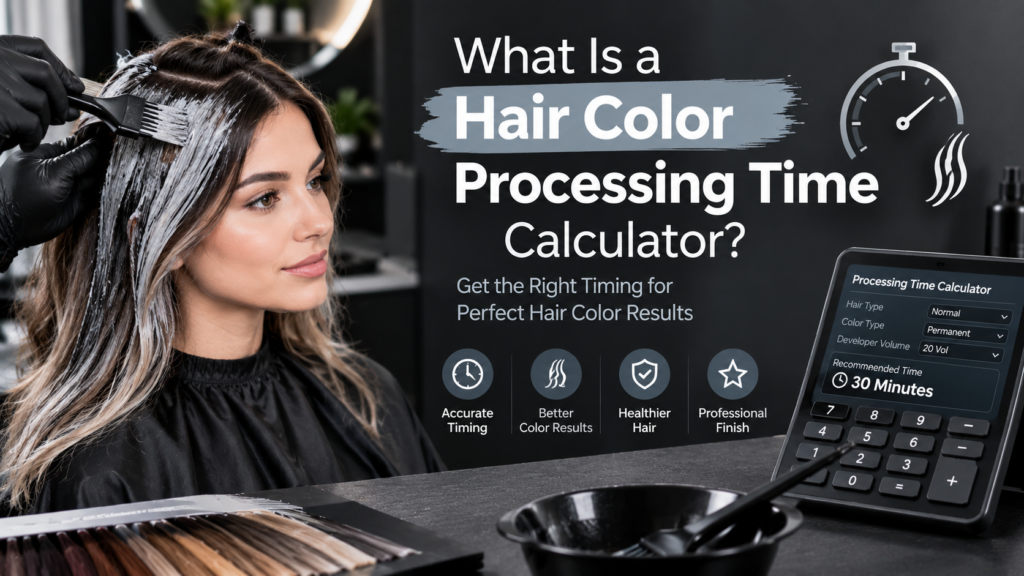
A hair color processing time calculator is a tool that estimates how long you should leave hair color on based on a few key inputs: the product type, developer volume, your current hair level, and your target level. Instead of guessing or relying on a generic “30 minutes” rule printed on every box, the calculator adjusts the recommendation to your actual situation.
Every hair type and formula behaves a little differently, so a one-size-fits-all timer rarely gives accurate results. A calculator narrows that gap by weighing the variables that actually matter for your specific service.
The goal isn’t just convenience, it’s protecting hair health. Hair color is a timed chemical reaction, and once that reaction is complete, leaving the product on longer doesn’t add more color. It only adds damage.
Understanding this distinction is what separates a controlled, predictable result from an accidental one. The calculator simply puts that professional logic into a quick, repeatable format.
Product Type
The single biggest factor in processing time is the type of product you’re using. Each formula interacts with hair differently, so timing varies significantly between categories. Knowing which one you’re working with is the first step in any accurate calculation.
Permanent color Opens the cuticle and deposits pigment permanently, requiring more time to complete. Because it penetrates the hair shaft, it needs the longest processing window of the standard categories.
Demi-permanent color Deposits color without lifting the natural shade, so it processes faster. It’s a gentler chemical reaction, which is why it’s often chosen for toning or refreshing rather than dramatic change.
Lightener (bleach) Works purely to lift pigment out of the hair and needs constant monitoring. It is the most reactive and time-sensitive of all the product types.
Toner A quick, low-volume step used to neutralize unwanted tones after lightening. It’s designed to make subtle adjustments rather than deposit heavy pigment.
Developer Volume
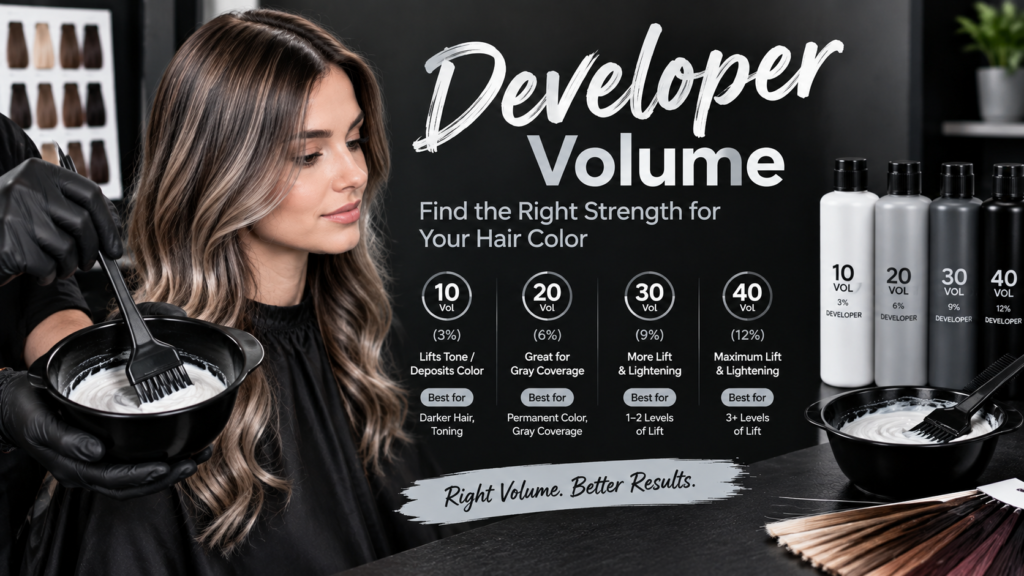
Developer (hydrogen peroxide) is what activates the color and determines how much lift you’ll get. It comes in different strengths, each suited to a different goal, and choosing the right one matters just as much as timing does.
| Developer Volume | Percentage | Typical Use |
| 10 Volume | 3% | Deposits color, little to no lift |
| 20 Volume | 6% | Standard lift, 12 levels, gray coverage |
| 30 Volume | 9% | Moderate lift, 23 levels |
| 40 Volume | 12% | Maximum lift, 34 levels, professional use only |
A common misconception is that a higher developer volume speeds up processing time. In reality, developer strength mainly controls how much lift you achieve, not how fast the color chemistry completes.
Switching to a higher volume is the right move if you’re not getting enough lift, rather than simply leaving a lower volume on longer. Extending time with a weak developer will not compensate for insufficient strength.
Current Level and Target Level
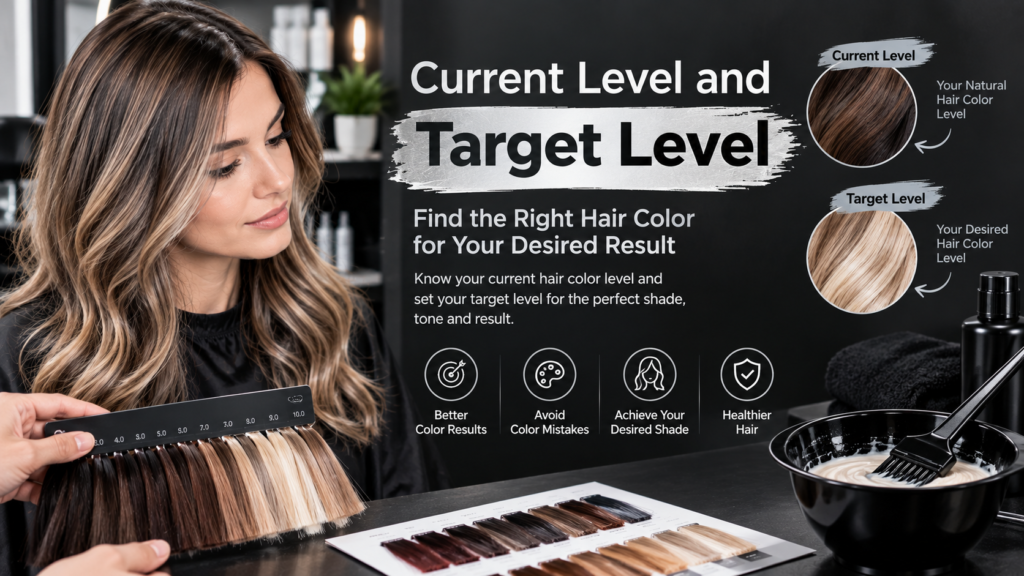
Your current level is how light or dark your hair is right now, usually measured on a 110 scale (1 being black, 10 being lightest blonde). Your target level is the shade you want to achieve. Together, these two numbers define how much chemical work the formula has to do.
The gap between these two numbers has a direct effect on timing:
- A small gap (12 levels) usually processes within the standard range.
- A larger gap (3+ levels) often needs a stronger developer and closer monitoring, rather than simply more time on the clock.
- Going darker generally processes faster than lifting several levels lighter.
This is why a proper calculator asks for both numbers; the difference between them tells the tool how aggressive the formula needs to be, which then informs the safe processing window. Skipping this step is one of the most common reasons at-home color jobs turn out uneven.
See More: Wella Color Chart 2026: Koleston Perfect, Color Touch & Complete Range Guide
Processing Time: What the Calculator Actually Estimates
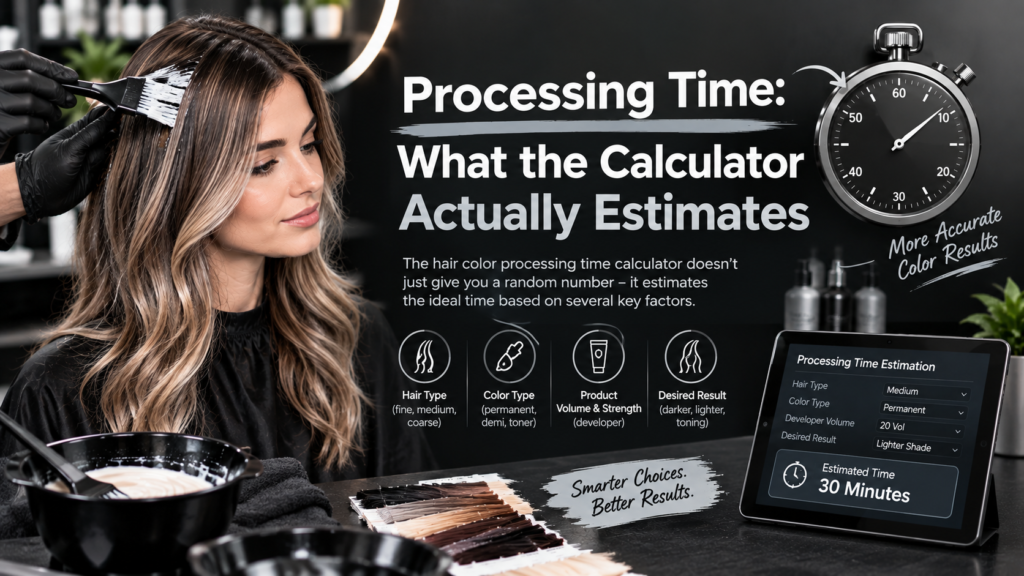
Once product type, developer volume, and level change are factored in, the calculator generates a recommended processing time range. Below is a breakdown of how each product category typically behaves, along with the reasoning behind the numbers.
Permanent Color
Permanent hair color usually needs 3045 minutes to fully process with a 20 volume developer. The chemical reaction happens in two phases: an initial coupling stage in the first 10 minutes, followed by a longer phase where the color molecules fully develop.
Once that reaction finishes, extra time on the hair doesn’t create more saturation, it just increases the risk of dryness. This is why watching the clock matters more than watching the color darken on the strand.
- 10 volume: 3540 minutes
- 20 volume: 3045 minutes
- 30 volume: 3035 minutes
Demi-Permanent
Demi-permanent color is ammonia-free and uses a low-volume developer (typically 610 volume), so it doesn’t need to penetrate as deeply. Processing time is shorter, usually 1525 minutes.
Because the formula is gentler, going past the recommended window can actually make results look duller rather than more saturated. The reaction simply plateaus, so patience past that point offers no benefit.
Lightener (Bleach)
Lightening is the most time-sensitive process of all. Processing time depends heavily on developer strength and how many levels of lift you need, and the margin for error is much smaller than with deposit-only color.
| Developer | Levels of Lift | Processing Time |
| 20 Volume | 23 levels | 2535 minutes |
| 30 Volume | 34 levels | 3040 minutes |
| 40 Volume | 4+ levels | 3550 minutes |
Bleach should never be left on longer than 5055 minutes under any circumstances. After that point, the peroxide is essentially exhausted; it stops lifting color and only continues to damage the hair. Checking progress every 10 minutes is a standard professional practice, and it’s the single best habit for avoiding breakage.
Toner
Toners are used after lightning to cancel out brassy or yellow undertones. Because they use very low-volume developers, processing time is short, generally 520 minutes, checked frequently to avoid overtoning.
Since the goal is subtle correction rather than dramatic change, even a few extra minutes can shift the result noticeably. Frequent visual checks matter more here than in almost any other step.
Factors That Modify Processing Time
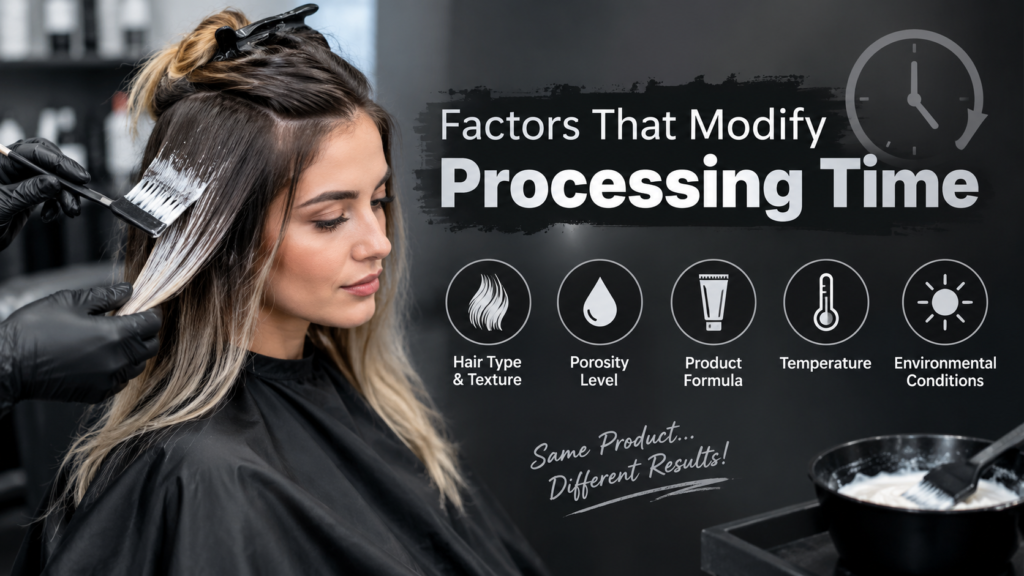
The base recommendation is only a starting point. Several real-world variables can shift the ideal timing up or down, and a good calculator or a careful colorist accounts for them before finalizing the estimate.
Hair porosity: Low porosity hair may need 510 extra minutes since the cuticle resists penetration. High porosity hair absorbs color faster and may need 510 minutes less to avoid overprocessing.
Gray percentage: Resistant gray hair often needs a few extra minutes and, in some cases, a stronger developer for full coverage. Gray strands have a tighter cuticle structure that slows pigment absorption.
Virgin vs. previously colored hair: Virgin hair typically needs the full standard time, while chemically treated hair processes faster and is more vulnerable to damage. Previously lightened hair especially should be timed conservatively.
Hair texture: Coarse hair tends to resist color longer than fine hair, since the strand diameter affects how quickly pigment molecules can travel through the cuticle.
Room temperature and heat: Processing under a warm cap or in a heated environment can speed up development, so timing should be adjusted down slightly to prevent overprocessing.
Brand-specific formulas: Always cross-check your calculator estimate against the manufacturer’s instructions, since formulas vary between brands even at the same developer volume.
Quick Reference Table
| Service | Developer Volume | Standard Processing Time |
| Permanent color | 20 Vol | 3045 min |
| Permanent color (resistant gray) | 2030 Vol | 3545 min |
| Demi-permanent | 610 Vol | 1525 min |
| Lightener (bleach) | 2040 Vol | 2550 min |
| Toner | 610 Vol | 520 min |
This table is a fast way to sanity-check any calculator result before you begin. If a recommended time falls far outside these ranges, it’s worth double-checking your inputs.
How to Use a Processing Time Calculator Correctly
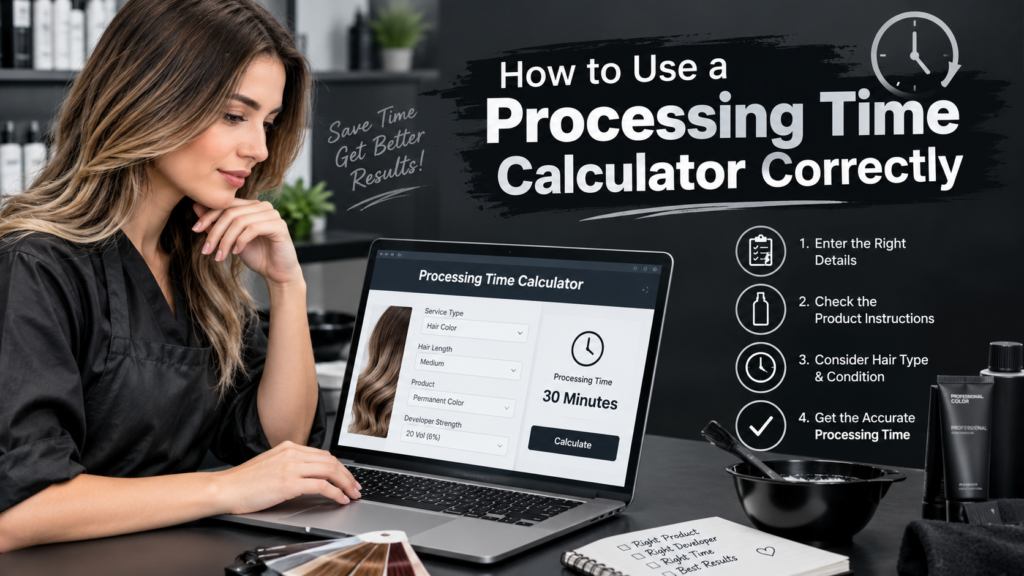
Getting an accurate estimate depends on entering the right information in the right order. Skipping a step, or guessing at a number, undermines the accuracy of everything that follows.
- Select your product type (permanent, demi, lightener, or toner).
- Choose the developer volume you’re using.
- Enter your current hair level.
- Enter your target level.
- Review the recommended time range and always do a strand test first.
- Check progress at the halfway mark, then every 10 minutes for bleach or high-lift services.
Following these steps in sequence keeps the estimate grounded in your actual hair, rather than a generic assumption. It also builds a habit of checking progress, which is the real safeguard against overprocessing.
A Quick Note on Accuracy
It’s worth remembering that any calculator including this one gives a general estimate based on typical formulas and average hair conditions. No tool can account for every variable in a single number.
Every head of hair is different, and factors like porosity, prior chemical treatments, and specific brand chemistry can shift the ideal timing. Two people with the same target shade may still need noticeably different processing windows.
For a service that’s been fine-tuned to your exact hair history and goals, a consultation with a professional colorist will always beat a generic calculation. Calculators are best used as a starting reference, not a final word.
Conclusion
Hair color processing time isn’t guesswork, it’s a chemical window with a clear start and endpoint. Understanding what drives that window, rather than following a flat rule printed on a box, is what leads to consistent, healthy results.
Using a hair color processing time calculator takes the uncertainty out of the equation by factoring in your product type, developer strength, and the level change you’re aiming for. It turns a vague estimate into a number grounded in your actual situation.
But calculators are a guide, not a guarantee: always pair the estimate with a strand test, regular checks, and the manufacturer’s instructions to protect your hair while getting the color result you actually want.





1 thought on “Hair Color Processing Time Calculator Calculate Your Perfect Timing”