
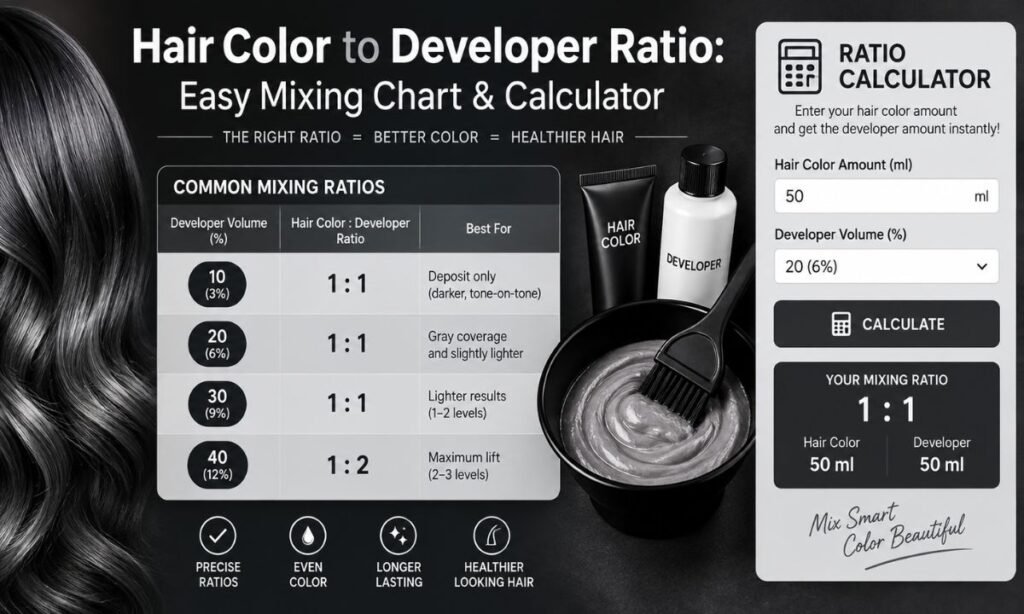
Getting your hair color right starts with using the correct hair color to developer ratio. The wrong ratio can affect coverage, lift, consistency, and the final shade, while the correct mix helps create more even and predictable results.
In this guide, you’ll find an easy hair color to developer ratio chart and calculator, along with simple mixing formulas for different amounts of color. We’ll also cover common ratios, grey coverage, toners, and bleach so you can measure and mix your products with confidence.
What Does the Dye-to-Developer Ratio Actually Mean?
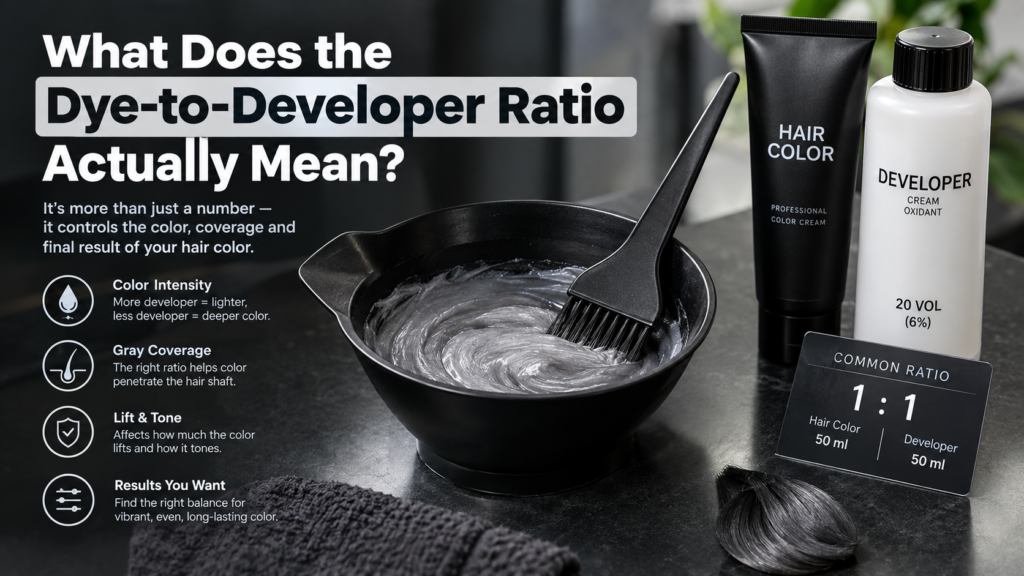
The hair color to developer ratio simply tells you how much developer (also called peroxide) to mix with how much hair dye. It’s written as two numbers, like 1:1 or 1:2, and it looks simple because it is.
The first number is always the hair color. The second number is always the developer. Once you understand this order, reading any box or professional formula becomes second nature.
So a 1:2 ratio means one part hair color to two parts developer. If you use 1 oz of color, you’ll need 2 oz of developer. Scale that up or down and the proportion always stays the same.
The developer isn’t just a filler ingredient sitting in the bottle for no reason. It’s the ingredient that opens the hair cuticle so the color pigment can get inside the hair shaft. Without it, permanent and demi-permanent dyes simply wouldn’t work at all.
The volume of the developer (10, 20, 30, or 40) controls how much lift you get, while the ratio controls how concentrated the mixture is. These are two separate variables, and confusing them is one of the most common errors new colorists make.
Think of the ratio as the “thickness” of your mix and the volume as the “strength” of your mix. You can have a thick, low-strength mixture or a thin, high-strength mixture, and each behaves very differently on the hair.
Understanding both variables together, rather than in isolation, is the real key to predictable results. A 1:1 mix with 40 volume behaves completely differently from a 1:2 mix with 10 volume, even though both involve the same basic ingredients.
Why the Order of the Numbers Matters
It’s easy to accidentally flip the ratio when you’re working quickly, especially in a busy salon environment. Flipping 1:2 into 2:1 completely changes the chemistry of the mixture and the final result on the hair.
Always double-check which number refers to color and which refers to developer before you start pouring. A few extra seconds of care here prevents a mixing mistake that can’t be undone once the product is on the hair.
When Should You Use Each Ratio?
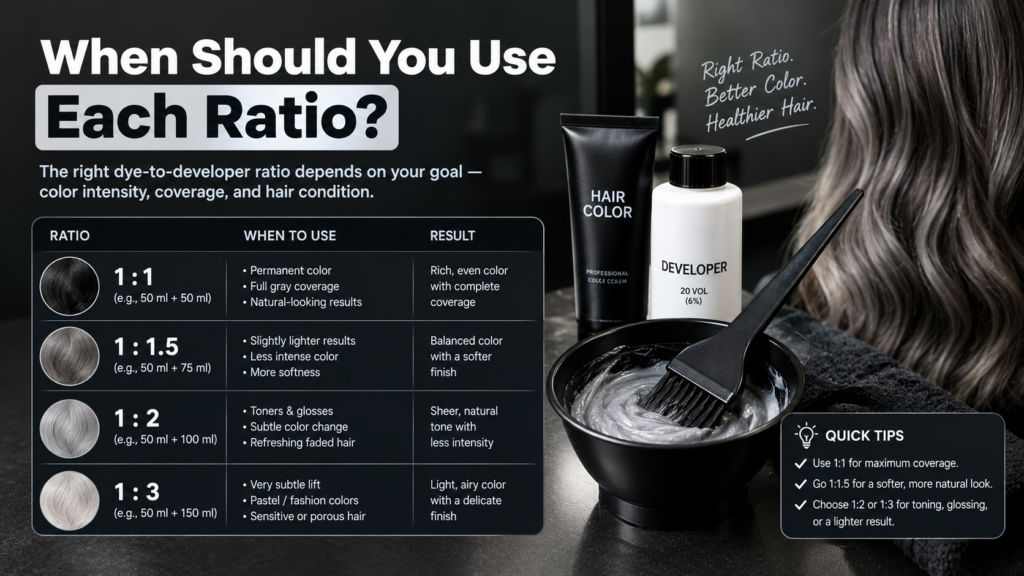
Most hair color lines use one of three standard ratios, and knowing which one fits your goal takes the guesswork out of every application. Here’s a quick breakdown of what each one is generally used for.
| Ratio (Color : Developer) | Best For | What It Does |
| 1:1 | Permanent color, grey coverage | Full pigment deposit, minimal lift |
| 1:1.5 | Demi-permanent color, some permanent lines | Slightly lighter mix, gentler processing, easier application |
| 1:2 | Toners, glosses, high-lift blondes, bleach | Maximum lift, lighter, more fluid consistency |
A 1:1 ratio is the most common choice for depositing rich, solid color with little to no lightening. It’s the workhorse ratio for anyone wanting to match or deepen their natural shade.
A 1:1.5 ratio strikes a balance between deposit and lift. It’s thinner to apply and gives slightly more movement than a straight 1:1 mix, which many colorists appreciate for even saturation.
A 1:2 ratio is used when you need serious lift, such as with bleach, high lift blondes, or ammonia-free toners. This thinner consistency spreads more easily but deposits less solid pigment.
Always check the manufacturer’s instructions first, since ratios can vary slightly by brand. Some professional lines even build their own recommended ratio directly into the product name or packaging.
How to Choose Between Ratios in Practice
If your main goal is coverage and depth, lean toward 1:1. If you’re chasing extra lift or a lighter, more refined finish, 1:1.5 or 1:2 will usually serve you better.
When in doubt, it’s almost always safer to start with the ratio printed on the box rather than guessing. You can always adjust on your next application once you see how your hair responds.
How to Mix Two Hair Color Shades Together?
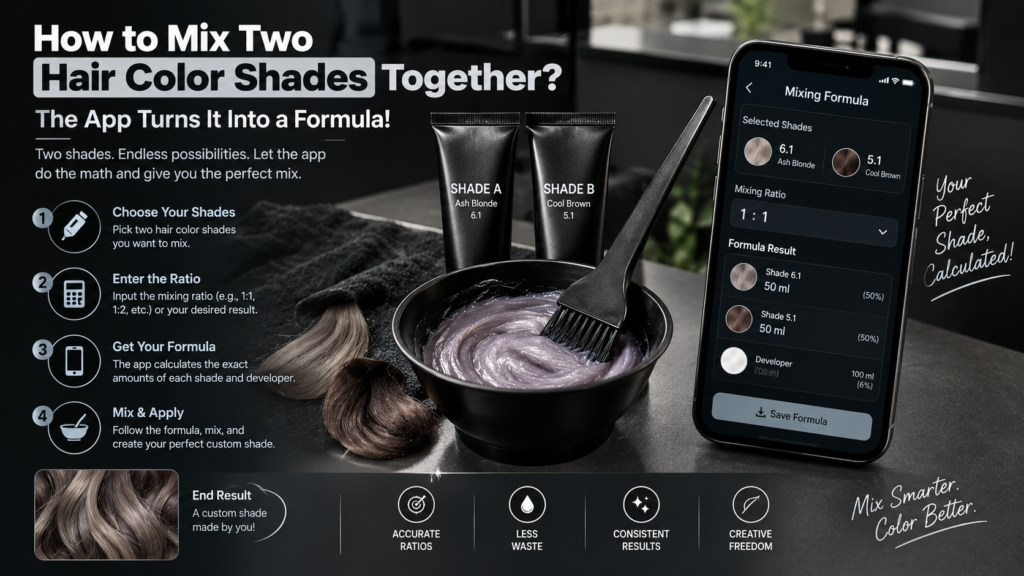
Sometimes the exact shade you want isn’t sitting on the shelf, so colorists blend two tubes of dye before adding developer. Custom blending is one of the most valuable skills a colorist can develop, since it opens up an almost unlimited range of shades.
The process is straightforward once you understand the basic steps, and it doesn’t require any special equipment beyond a mixing bowl and a brush.
- Pick two shades that are close in level (lightness/darkness) or that you want to blend intentionally for a specific tonal effect.
- Decide on your blend ratio between the two colors equal parts, or a heavier ratio of one shade over the other.
- Combine both colors thoroughly in the bowl before adding developer, making sure there are no streaks of a single shade left.
- Add developer at your usual ratio (1:1, 1:1.5, or 1:2), based on the total weight of both colors combined, not each shade separately.
- Mix until you get a smooth, streak-free consistency with no visible separation between the two original shades.
Skipping the step of blending the colors together first, before adding developer, is a common mistake. If developer is added too early, the two shades can process unevenly and leave the final result blotchy.
Practical Example: Two-Shade Blend
Say you want a warm beige blonde by combining an ash blonde and a golden blonde. This is a classic blending trick used to neutralize unwanted tones while still keeping a natural finish.
- 1 oz Shade A (7/1 Ash Blonde)
- 1 oz Shade B (7/3 Golden Blonde)
- 2 oz total color
Since the total color is 2 oz, and you’re using a 1:1 developer ratio, you’d add 2 oz of developer. The ash and gold tones neutralize each other, giving you a soft, natural-looking beige blonde.
This same method works for almost any two shades you want to combine, as long as you keep the total combined color weight in mind when calculating the developer. It’s simple math once you get the hang of it.
What Happens When You Mix Shades at Different Percentages?
The result shifts based on how much of each shade you use, not just which two shades you pick. The ratio between the shades themselves is just as important as the developer ratio.
- Equal parts (1:1) – The final color sits right in the middle of both shades, blending their tones and levels evenly.
- More of Shade A – The final result leans closer to Shade A’s tone and level, with Shade B acting more like an accent.
- More of Shade B – The final result leans closer to Shade B’s tone and level instead.
As a rule of thumb, the final level is roughly the weighted average of the two shades used. If you combine a level 6 and a level 8 in equal parts, expect something close to a level 7.
This weighted-average approach also applies to tone, not just level. Blending a warm shade with a cool shade in unequal amounts will pull the final color noticeably toward whichever tone makes up the larger portion.
How Does the Ratio Affect Processing Time?
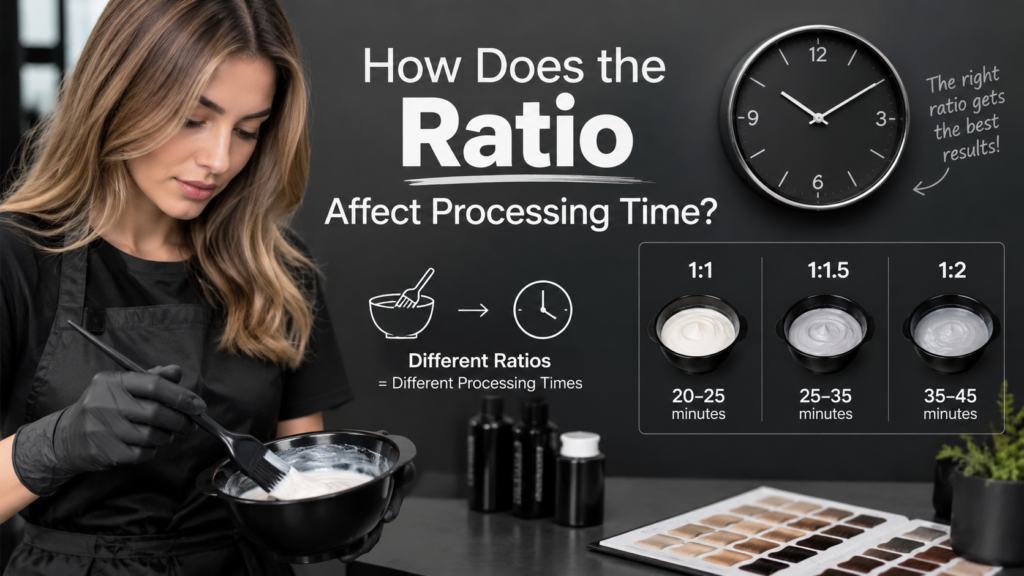
The ratio you choose changes how the color behaves on your hair, and that can affect timing in ways that are easy to underestimate. A thinner mixture doesn’t just apply differently it can process differently too.
Higher developer ratios (1:2) thin out the mixture, which can speed up penetration but may also reduce how deeply the pigment deposits if left too long or too short. Timing becomes more important, not less, with a thinner mix.
Lower developer ratios (1:1) are thicker and deposit color more solidly, usually processing within the standard 20–45 minute window listed on the box. This is the more forgiving option for beginners.
Processing time is mostly set by the brand’s instructions, not by the ratio alone but a thinner (1:2) mix can feel like it “grabs” faster on porous or grey hair. Hair porosity plays a major role here and shouldn’t be ignored.
Always set a timer and check strands partway through, especially the first time you try a new ratio or brand. A strand test halfway through processing tells you far more than guessing based on the clock alone.
See More: Hair Bleaching Time: How Long Does It Take? Stages & Complete Chart Guide (2026)
Factors Beyond the Ratio That Influence Timing
Room temperature, hair porosity, and the natural thickness of the hair strand all interact with your chosen ratio to change processing speed. Warmer rooms and more porous hair tend to process faster regardless of ratio.
Because of this, the same 1:1 mix can behave differently from one head of hair to another. Building the habit of checking a test strand removes most of the guesswork from this variability.
What Are the Most Common Mistakes When Mixing Hair Dye?
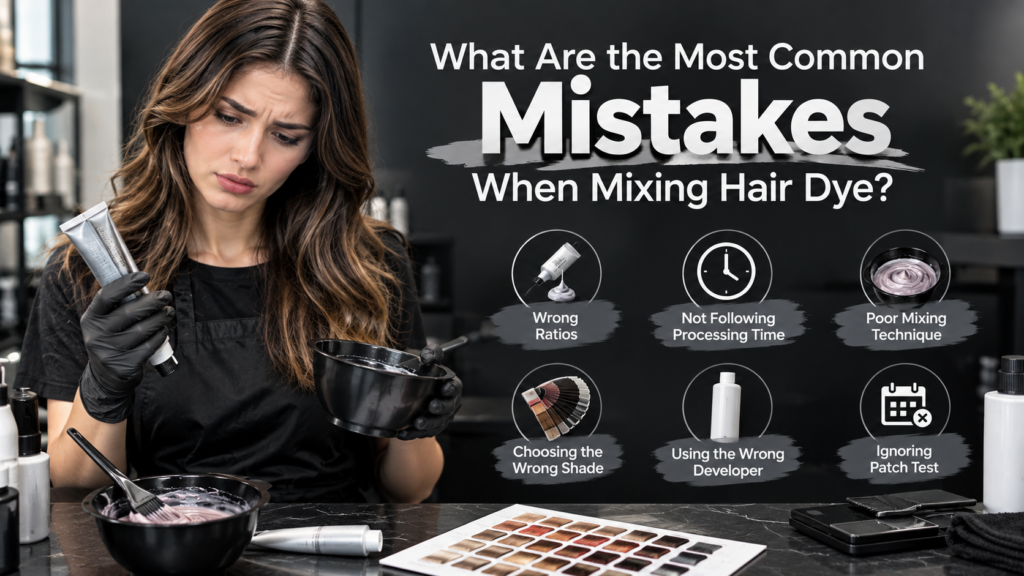
Even experienced colorists slip up here, and small errors in mixing are responsible for a surprising number of color disasters. Watch out for these common pitfalls the next time you mix a formula.
- Eyeballing measurements instead of using a scale or measuring cup small errors throw off the whole ratio and compound quickly.
- Using the wrong developer volume for the result you want, such as reaching for 40 volume when you only need a level or two of lift.
- Mixing in a metal bowl, which can react with the developer and destabilize the mixture before it even touches the hair.
- Assuming a stronger ratio equals better grey coverage coverage actually comes from pigment deposit and processing time, not from adding more developers.
- Not stirring thoroughly, which leaves streaks of unmixed developer or color that show up as patchiness later.
- Ignoring the manufacturer’s recommended ratio printed on the box or tube, even when it conflicts with a habit you’ve picked up over time.
Each of these mistakes is easy to avoid once you know to look out for it. Most come down to rushing the mixing step instead of treating it with the same care as the application itself.
Simple Habits That Prevent Mixing Errors
Keeping a dedicated plastic or glass mixing bowl, a small kitchen scale, and a notebook of your go-to ratios can eliminate almost all of these mistakes. Consistency in your tools leads directly to consistency in your results.
Taking thirty extra seconds to double-check a ratio before adding a developer is a small investment that protects hours of work and, often, an expensive correction service down the line.
What Ratios Should You Use for Specific Techniques?
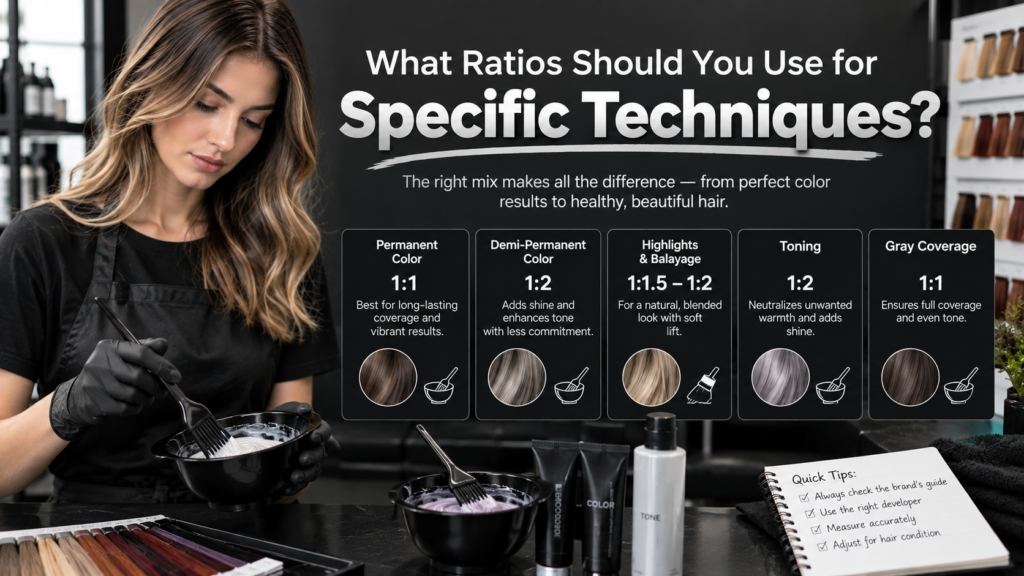
Different color services call for different ratios, and matching the ratio to the technique is where real skill and confidence come from. Here’s how it typically breaks down across the three most common services.
100% Grey Coverage
Grey hair has no natural pigment, so the goal is maximum color deposit, not lift. This distinction matters because many people mistakenly reach for a stronger developer when their real problem is timing or application technique.
A 1:1 ratio with a 20-volume developer is the standard combination for full grey coverage on most permanent color lines. This combination is thick enough to saturate stubborn grey strands thoroughly.
Stubborn, resistant greys sometimes benefit from a 1:1.5 ratio or a slightly longer processing time instead of a stronger developer. Reaching for 30 or 40 volume to “fix” resistant grey is a common but ineffective shortcut.
Pre-softening resistant grey hair before applying color can also improve results dramatically, often more than adjusting the ratio ever will. This extra step is worth the additional few minutes it takes.
Lightening and Bleaching Techniques
Bleach and high-lift color need a thinner, more fluid mixture to lift multiple levels efficiently. The consistency needs to be loose enough to spread evenly without dragging on the hair.
A 1:2 ratio (bleach powder to developer) is the common standard, often paired with 20, 30, or 40 volume developers depending on how much lift is needed. Higher volumes are reserved for hair that needs significant lightening.
Higher developer volumes lift more but also carry a higher risk of damage, so they should be matched carefully to hair condition. Fine or already-compromised hair rarely tolerates the highest volumes well.
A patch test and strand test are especially important with bleach mixtures, since the combination of a thin ratio and high volume developer can process much faster than expected.
Toners and Ammonia Free Color
Toners and gloss treatments are designed to refine color rather than lift it dramatically, so they typically use a 1:2 ratio with a low-volume developer, often 10 volumes. This keeps the chemistry gentle.
This keeps the mix gentle while still allowing the toning pigments to neutralize brassiness or refresh faded color. The thinner consistency also helps toner glide evenly across already-lightened hair.
Because toners work on hair that has usually already been processed once, gentleness matters more here than in almost any other step. A stronger mix than necessary can quickly overcorrect the tone.
Quick Hair Color to Developer Calculator (By Weight)
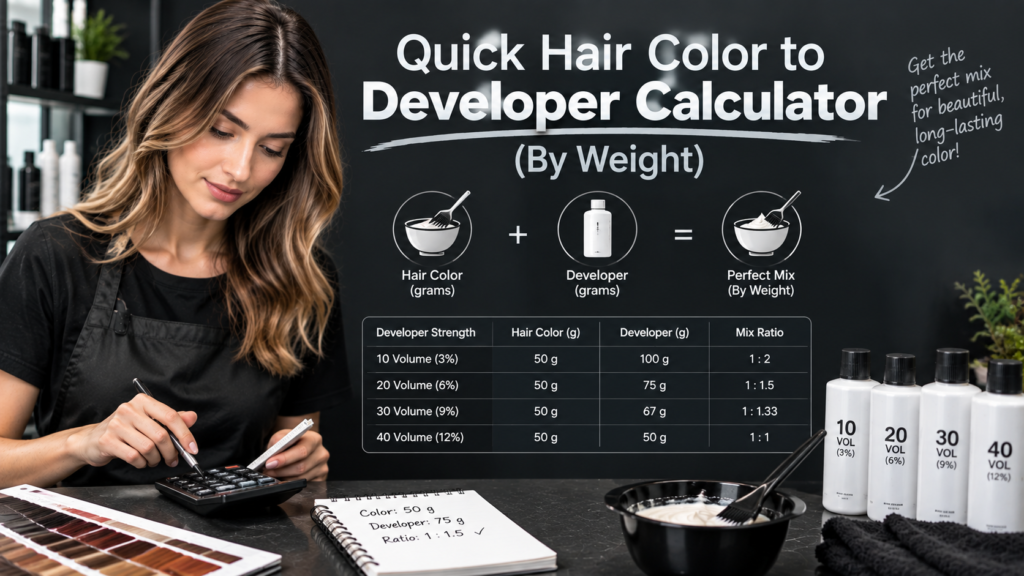
Use this simple formula to calculate your mix at home, whether you’re working with a small touch-up or a full head of color. The math stays consistent no matter the quantity.
Developer amount = Color amount × Ratio multiplier
| Color Used | 1:1 Ratio | 1:1.5 Ratio | 1:2 Ratio |
| 1 oz | 1 oz developer | 1.5 oz developer | 2 oz developer |
| 2 oz | 2 oz developer | 3 oz developer | 4 oz developer |
| 3 oz | 3 oz developer | 4.5 oz developer | 6 oz developer |
| 4 oz | 4 oz developer | 6 oz developer | 8 oz developer |
For a full head of medium-to-long hair, most colorists prepare somewhere between 4 to 6 oz of total mixture, adjusting up for thicker or longer hair. Short hair or touch-ups typically need far less.
Adjusting the Chart for Your Own Hair
If your hair is unusually thick, dense, or long, it’s worth preparing slightly more than the chart suggests so you don’t run short mid-application. Running out of product partway through can lead to uneven color.
Keep leftover mixed product out of your final calculations for next time, since mixed developer and color begin to lose effectiveness once combined and shouldn’t be saved for later use.
Frequently Asked Questions
What is the standard hair color to developer ratio?
The most common standard is 1:1, meaning equal parts hair color and developer.
Can I use a 1:2 ratio for regular hair color?
Yes, but it’s usually reserved for lighteners, toners, and high-lift shades rather than standard permanent color.
Does more developer mean lighter hair?
More developer relative to color increases lift, but the developer’s volume (10–40) also plays a major role.
What ratio is best for grey hair coverage?
A 1:1 ratio with 20-volume developer is the standard choice for full grey coverage.
Can I mix two different hair color brands together?
It’s not recommended, since different brands use different chemical bases and developer strengths.
How long should I process hair color after mixing?
Most formulas process within 20–45 minutes, but always follow the specific product’s instructions.
Conclusion
The hair color to developer ratio isn’t just a technical detail it’s the foundation of predictable, salon quality results. Whether you’re covering greys with a 1:1 mix, lifting with a 1:2 bleach blend, or refining tone with a gentle toner ratio, matching your ratio to your goal makes all the difference.
Small mistakes in mixing, like eyeballing measurements or ignoring the manufacturer’s instructions, are responsible for far more color disappointments than shade selection ever is. Taking the extra minute to measure carefully pays off every single time you color.
Keep a scale or measuring cup handy, follow your brand’s instructions, and use the chart above whenever you need a quick reference. With a little practice, getting your ratio right becomes second nature rather than a source of stress.





1 thought on “Hair Color to Developer Ratio: Easy Mixing Chart & Calculator”