

Every great color service starts long before the brush touches the hair. It starts with understanding why a formula works, not just following a recipe from memory. That is exactly what hair colorimetry teaches you.
If you have ever mixed a formula that turned out too warm, too ashy, or just plain wrong, the problem usually is not the product. It is a gap in the underlying theory. Colorists who rely only on memorized recipes often struggle the moment a client’s hair does not match the “typical” case.
This guide breaks down the core principles of hair colorimetry in plain, practical language. The goal is to help you formulate with confidence, avoid costly redos, and get predictable results every single time you sit a client in the chair.
Colorimetry is not an abstract academic subject reserved for advanced training courses. It is a working toolset that every colorist uses, whether they realize it or not, each time they choose a shade and a developer strength.
What Is Hair Colorimetry?
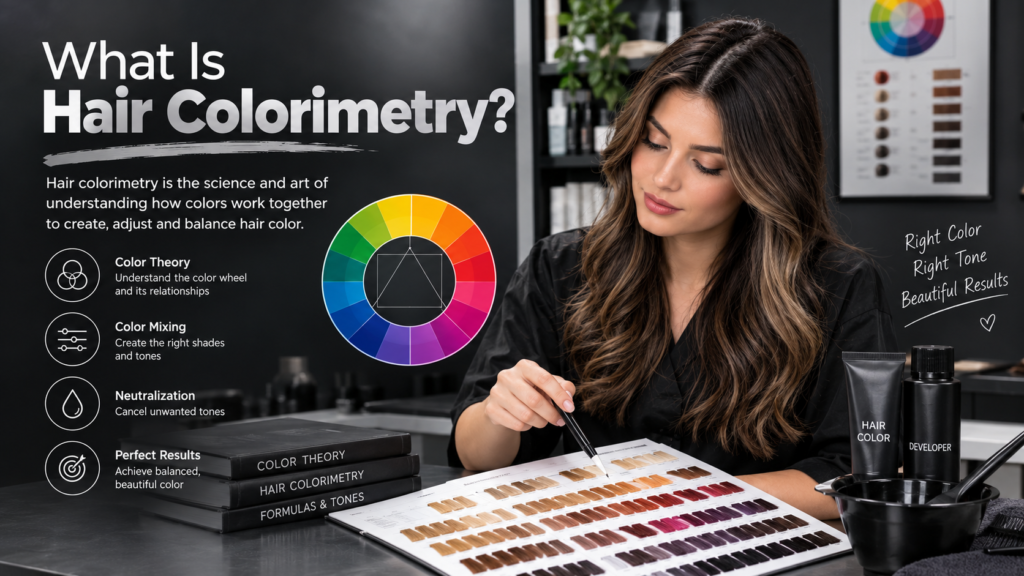
Hair colorimetry is the science of how color pigments interact inside the hair shaft. It combines color theory, the level system, and tone (reflect) numbering to help colorists predict exactly what will happen when a specific formula meets a specific head of hair.
At its core, colorimetry is about prediction. Instead of hoping a formula turns out well, a colorist trained in colorimetry can look at the hair, run the numbers, and know in advance roughly what result to expect.
In short, colorimetry answers three questions for every client:
- How dark or light is the hair right now, and how dark or light should it be?
- What warmth or coolness is hiding underneath that needs to be managed?
- Which product, developer, and ratio will get you there safely?
Once you understand these fundamentals, formulation stops being guesswork and becomes a repeatable, logical process. Every shade on the shelf becomes a tool with a known purpose, rather than a mystery bottle.
Why Colorimetry Matters in Daily Salon Work
Clients rarely ask for “a level 6 with a .13 reflect.” They ask for “beige,” “ash blonde,” or “warm caramel.” Colorimetry is the bridge between that everyday language and the technical formula that actually produces it.
Without this bridge, colorists tend to guess based on what worked last time, even when the starting hair is completely different. That is how redos happen, and redos cost time, product, and client trust.
How Does Color Theory Work in Hair Colorimetry?
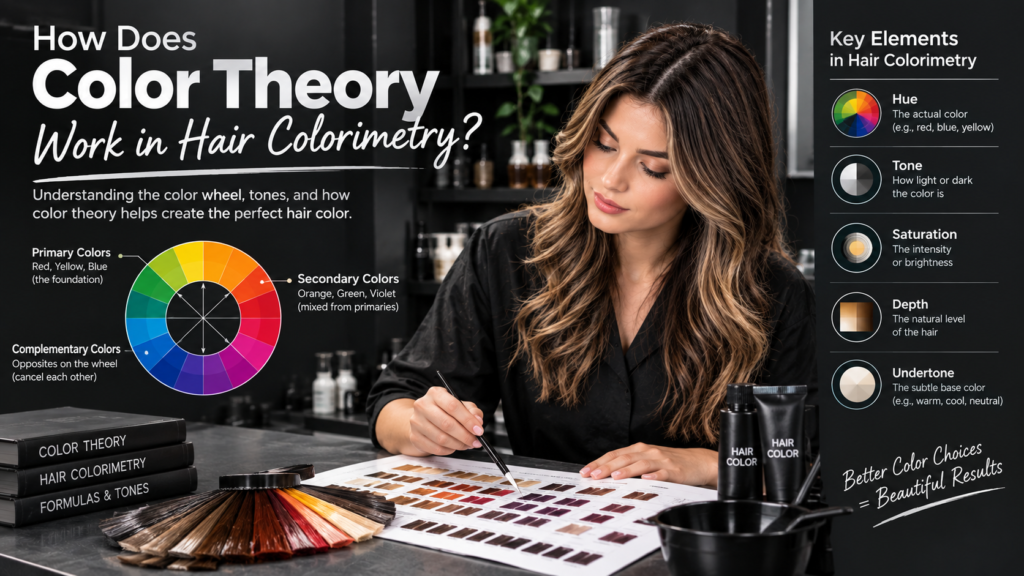
Color theory in hair coloring is built on the same color wheel used in art and design, but it is applied specifically to pigment behavior inside the hair shaft rather than pigment on a canvas.
Understanding the wheel means understanding which colors combine to create warmth, which combine to create coolness, and which colors cancel each other out completely when mixed in the right proportion.
Primary Colors
In hair colorimetry, the three primary colors are blue, red, and yellow. Every underlying pigment and every reflection on the shelf is ultimately a combination of these three foundational tones.
These primaries cannot be created by mixing other colors together, which is why they form the base layer of the entire system. Every commercial reflects the number traced back to one or more of them.
| Primary Color | Common Reflect Code | Where It Shows Up |
| Blue | .1 (ash) | Cools down warmth, dominant in dark levels |
| Red | .6 (red/mahogany) | Warm, intense, strong in mid-dark levels |
| Yellow | .3 (gold) | Warm and luminous, dominant in lighter levels |
Secondary Colors
Secondary colors form when two primaries mix together in roughly equal parts. Orange, green, and violet are the three secondary tones colorists encounter most often behind the chair.
Orange (red plus yellow) and yellow itself are the pigments naturally exposed during lightning, which is why so much of tone correction work revolves around managing these two warm tones specifically.
Green (blue plus yellow) and violet (blue plus red) appear less often as underlying pigment, but they are essential correction tools, since they sit directly opposite the warm tones colorists most need to neutralize.
Complementary Colors
Complementary colors sit opposite each other on the color wheel, and they cancel each other out when combined in the correct ratio. This single rule is the backbone of all tone correction work in the salon.
- Violet neutralizes yellow
- Blue neutralizes orange
- Green neutralizes red
Knowing these three pairs by heart will save you more formulation headaches than any product brochure ever will. When a result comes out wrong, the fix is almost always found by identifying which of these pairs was missing.
What Are Color Levels and How Are They Used for Formulation?
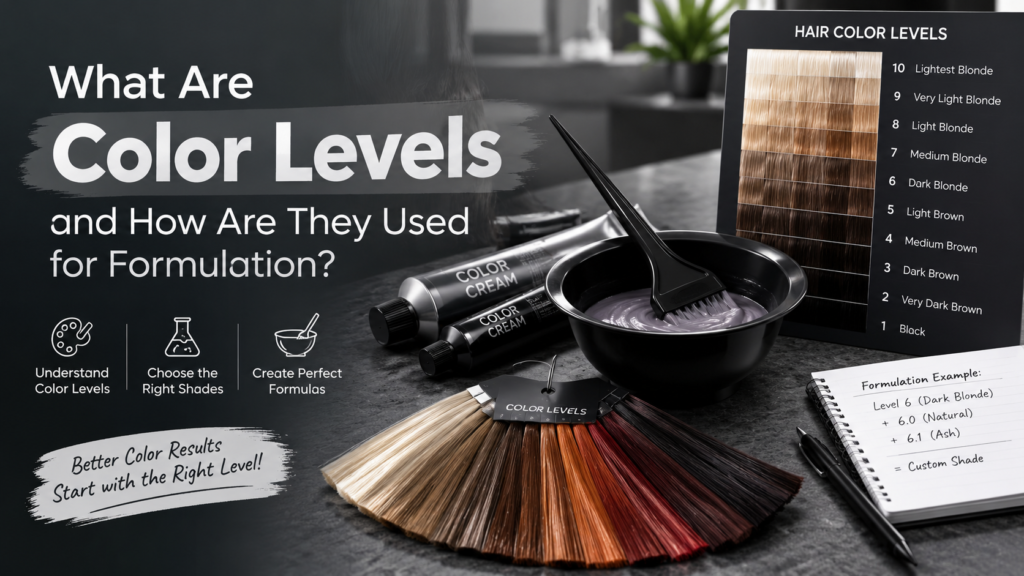
The level system measures how light or dark hair is on a universal 1–10 scale, regardless of brand. Level 1 is black, and level 10 is the lightest pale blonde achievable.
Every formulation decision, including developer strength, processing time, and reflect choice, starts with identifying the correct starting level. Get the level wrong, and every decision that follows will be built on a false foundation.
Color Level Chart with Underlying Pigments
| Level | Depth | Underlying Pigment |
| 1–2 | Black / darkest brown | Red |
| 3–4 | Dark to medium brown | Red-orange |
| 5–6 | Light brown | Orange |
| 7–8 | Dark to medium blonde | Orange-yellow |
| 9–10 | Light to lightest blonde | Pale yellow |
This chart is not just theory. It is a practical map of what pigment you will be looking at, and working against, at every stage of a lightning service.
See More: Hair Color to Developer Ratio: Easy Mixing Chart & Calculator
How to Identify the Natural Level
Always check the level at the regrowth area, in natural light, against a professional level chart. Never rely on salon lighting alone, and never judge the level of hair that has already been color-treated.
The root area gives you the truest reading of natural depth and grey percentage. Even a small amount of natural daylight near a window can dramatically change how accurately you assess a client’s true starting point.
The Rule of 4 Tones
A well-known formulation guideline states that oxidative hair color can typically lift natural hair a maximum of four levels in a single session. This is not a suggestion; it reflects a real chemical limit of standard color.
Pushing beyond that limit with color alone, instead of switching to a lightener, usually means uneven results and unnecessary hair damage. When a client wants more than four levels of lift, planning multiple sessions is the safer, more professional path.
What Do the Numbers After the Decimal Point in Hair Dye Numbering Mean?
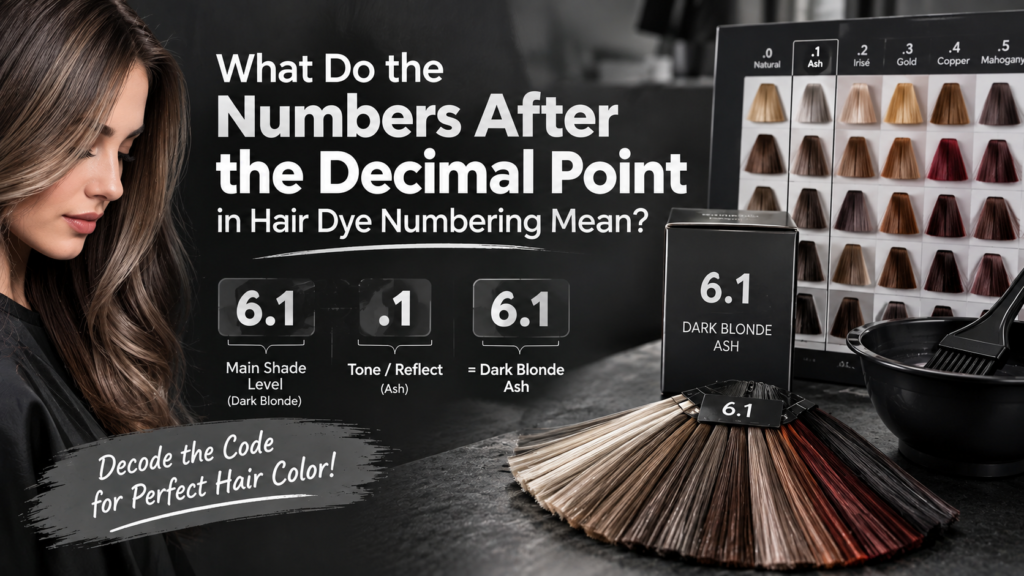
Every professional shade uses a two-part code: a number before the decimal, which represents the level, and one or more numbers after it, which represent the reflect or tone direction.
Understanding this numbering system turns a wall of confusing shade names into a logical code that can be read at a glance, box after box, brand after brand.
Universal Reflect Numbering
| Reflect Code | Tone Family |
| .0 | Natural |
| .1 | Ash (cool, blue-based) |
| .2 | Violet/Iridescent |
| .3 | Gold |
| .4 | Copper |
| .5 | Mahogany |
| .6 | Red |
| .7 | Matte/Green |
How to Read the Numbering
A shade like 7.31 means: level 7, with a dominant gold reflect (.3) and a secondary ash reflect (.1). The first digit after the decimal is always the dominant tone, and anything after it is a supporting reflection.
Reading shades this way lets a colorist walk into any brand’s color line and understand roughly what a formula will do, even without prior experience with that specific product range.
Rules for Mixing Reflects
- Never combine more than two or three reflects in one formula, or the result turns muddy.
- Cool reflects (.1, .2) neutralize warmth, while warm reflects (.3, .4, .5, .6) add richness and depth.
- Always match reflects within the same product line whenever possible, since cross-brand reflects are not calibrated the same way.
These rules exist because reflects are not infinitely combinable. Each additional reflection added to a formula dilutes the clarity of the final tone, so restraint is a skill in itself.
What Volume of Developer Should I Use and Why Does It Matter So Much?
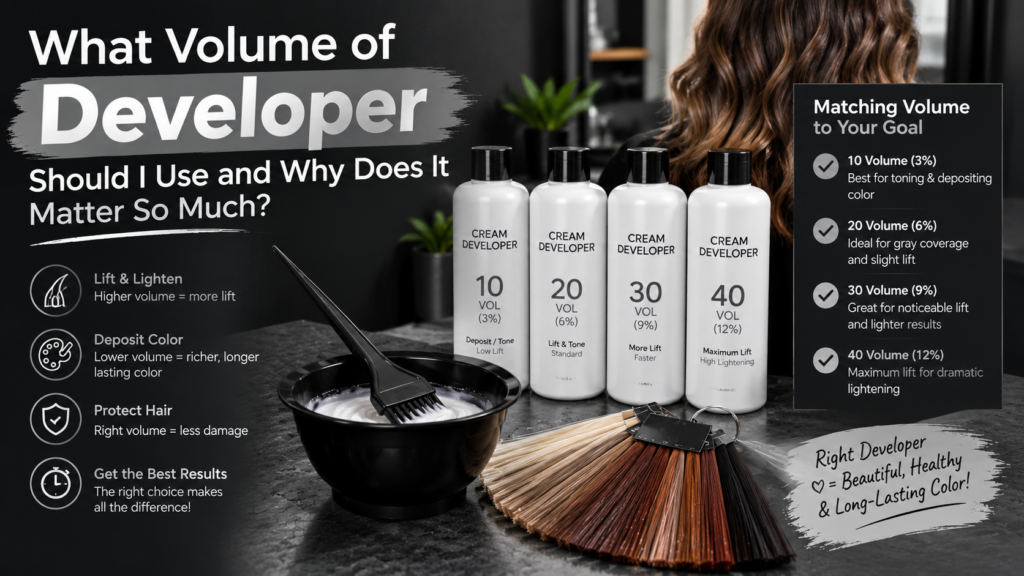
Developer, the peroxide mixed with dye, is what activates the color and controls how many levels of lift are possible. Choosing the wrong volume is one of the fastest ways to under-process or over-process a client’s hair.
Developer strength is not just about lift; it also affects processing time, how gently or aggressively the cuticle is opened, and how much stress the hair fiber will endure during the service.
Developer Volumes and Their Lightening Power
| Developer Volume | Peroxide % | Lift Achieved | Best For |
| 10 Vol | 3% | Deposit only, no lift | Toning, glazing, darkening |
| 20 Vol | 6% | 1–2 levels | Grey coverage, gentle lift |
| 30 Vol | 9% | 2–3 levels | Highlights, resistant hair |
| 40 Vol | 12% | 3–4 levels | Fast lightening (higher damage risk) |
Choosing a higher volume than needed does not simply speed up the process; it also increases the risk of damage, uneven porosity, and unwanted brassiness in the final result.
Hair Dye-to-Developer Ratios
The most common industry-standard ratio is 1:1, meaning equal parts color and developer. Some lightening or high-lift lines require a 1:1.5 or 1:2 ratio instead.
Always check the manufacturer’s instructions before mixing, since ratios are formulated specifically for each product line and are rarely interchangeable across brands without affecting the result.
How Are Unwanted Tones Neutralized in Hair Colorimetry?
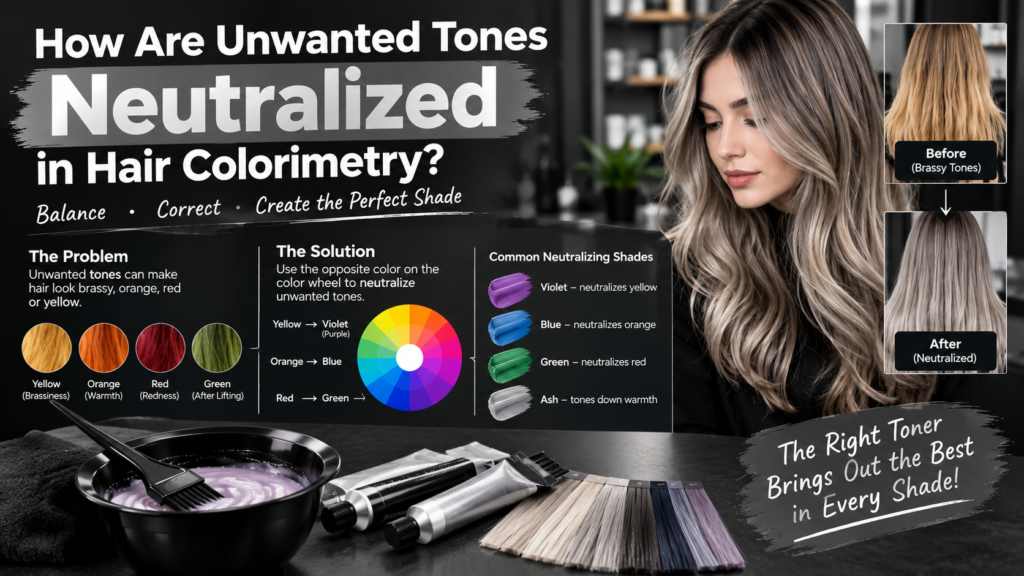
Neutralization is simply applying the complementary color wheel rule to real, working formulas. It is the single most practical application of everything covered so far in this guide.
Basic Principle
To cancel an unwanted warm or cool undertone, add its opposite on the color wheel in a small, controlled proportion. It should never be added as a stand-alone, undiluted reflect.
The goal of neutralization is balance, not domination. Adding too much of the opposite tone simply replaces one unwanted cast with another.
Practical Cases
- Orange undertone (levels 5–6): blend in a small amount of ash (.1) reflect.
- Yellow undertone (levels 8–9): blend in a small amount of violet (.2) reflect.
- Red undertone (levels 3–4): blend in a small amount of green/matte (.7) reflect.
Using too much corrector is one of the fastest ways to overcorrect into an unnatural, muddy result. Start conservatively, evaluate the strand test, and build up gradually if more correction is genuinely needed.
What Information Do You Need to Collect Before Formulating?

A strong formula begins with a proper consultation, not a color chart. Skipping this step is one of the most common reasons formulas fail even when the math looks correct on paper.
Hair History
Ask about previous color services, box dye use, keratin treatments, and any metallic or henna-based products. These all affect how the hair will react to a new formula, sometimes unpredictably.
Metallic salts in particular can cause dangerous heat reactions when combined with oxidative color, so this question is not optional, even when a client insists their hair has “nothing” on it.
Current Condition
Check porosity, elasticity, grey percentage, and existing level and tone before choosing developer strength or processing time. Hair in compromised condition simply cannot be treated the same as healthy, virgin hair.
Porosity in particular affects how quickly color deposits and how quickly it fades afterward, so it should influence both the formula chosen and the timing applied during the service.
Desired Result
Confirm the client’s target level and tone, and set realistic expectations about how many sessions it will take to get there safely. A clear, written or verbal agreement here prevents disappointment later.
Photos are useful, but they should be discussed critically, since lighting and hair texture in a reference photo can make a shade look different than it will on the client’s actual hair.
How Do You Formulate a Hair Color Step by Step?
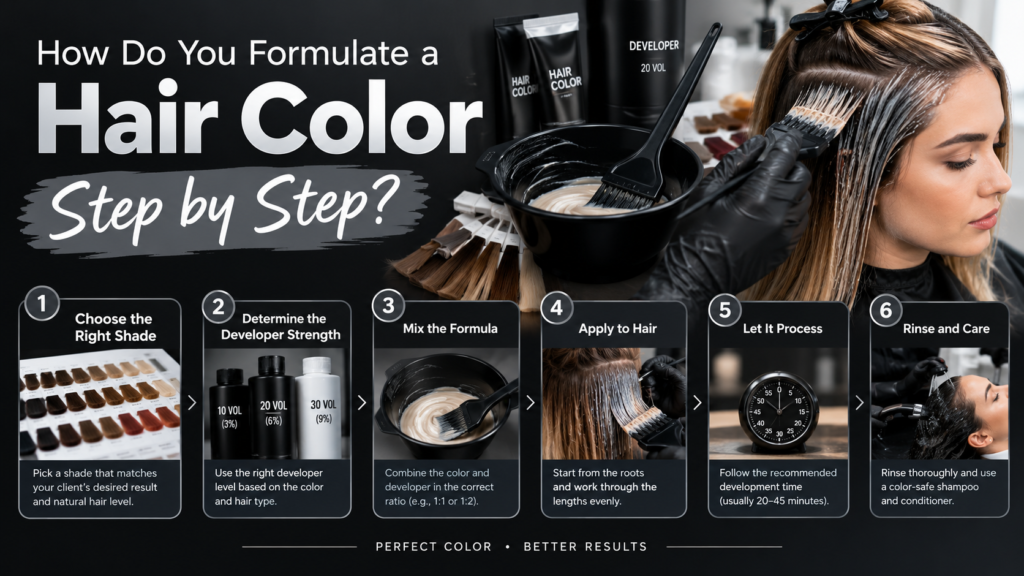
Once you have all the diagnostic information, formulation follows a logical five-step sequence. Following these steps in order removes guesswork from even the most complex color corrections.
Step 1: Determine the Target Level
Decide the final level the client wants, based on their natural or current level. This decision anchors every calculation that follows in the rest of the process.
Step 2: Calculate the Level Difference
Subtract the current level from the target level. This number determines how much lift is needed and, therefore, which developer volume should be used for the service.
Step 3: Consider the Underlying Pigment
Identify the pigment that will be exposed at the target level so you know exactly what needs to be neutralized, enhanced, or simply worked with in the final formula.
Step 4: Choose the Reflects
Select a reflect that either neutralizes the exposed pigment or enhances the desired warmth, depending entirely on the client’s stated goal from the consultation.
Step 5: Calculate the Ratios
Mix the color and developer according to the brand’s recommended ratio, adjusting volume based on the level difference calculated back in Step 2.
Practical Example
A client is at a natural level 5 and wants level 7 with a soft beige result. Working through the steps above makes the formula clear rather than guessed.
- Level difference: 7 − 5 = 2 levels, so use 20 Vol developer.
- Underlying pigment at level 7: orange-yellow, which needs mild ash/violet correction.
- Formula: a level 7 beige/ash shade (7.13) mixed 1:1 with 20 Vol developer.
Always confirm with a strand test before full application, since even a correct formula on paper can behave differently on a specific client’s hair.
What Are the Most Common Hair Color Formulation Mistakes?
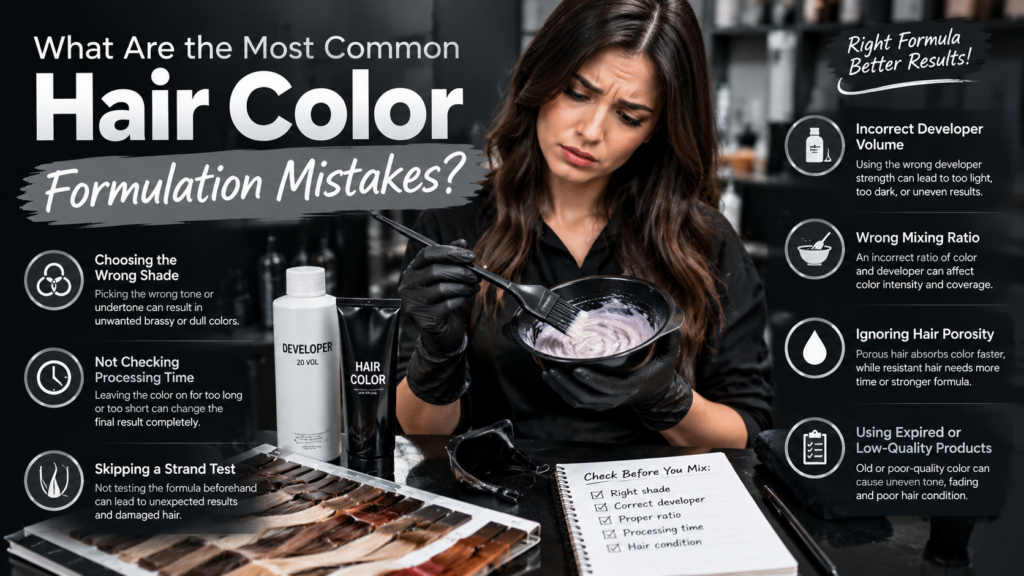
Even experienced colorists fall into these traps when they skip the fundamentals under time pressure or habit. Recognizing them is the first step toward avoiding them consistently.
1. Diagnosing by Eye
Guessing the level and tone without checking the natural regrowth in proper lighting leads to inaccurate formulas from the very first step of the process.
2. Ignoring Hair History
Skipping questions about prior chemical services can cause unexpected reactions, breakage, or uneven color that only becomes visible after the formula has already been applied.
3. Using Too Much Corrector
Overloading a formula with neutralizing reflections often creates a flat, muddy, or unnatural-looking result instead of the clean, balanced tone the client actually wanted.
4. Not Performing a Strand Test
Skipping the strand test removes your only safety check before committing to a full head application, leaving no early warning if the formula behaves unexpectedly.
5. Mixing Different Brands
Combining color lines from different manufacturers can produce unpredictable chemical reactions and inconsistent results, since each brand’s pigments are calibrated to work within its own system.
Frequently Asked Questions
What is the easiest way to identify a client’s natural level?
Check the regrowth area in natural daylight against a professional level chart, since salon lighting and previously colored lengths can be misleading.
Can I lift hair more than 4 levels with color alone?
Not safely in one session. Beyond four levels typically requires a lightener or a multi-session plan to protect hair integrity over time.
Why did my formula turn out orange instead of the shade on the chart?
The underlying pigment at that level was likely orange and was not neutralized enough with an ash or blue-based reflect before or during the service.
What developer volume is safest for grey coverage?
20 volume developer is the standard choice for grey coverage, since it opens the cuticle enough for even penetration without excessive lift.
Do all brands use the same numbering system?
The level scale (1–10) is universal, but exact reflect codes and shade names can vary slightly between brands, so always check each line’s own color chart.
Conclusion
Hair colorimetry is not just theory for textbooks. It is the practical toolkit that separates a lucky guess from a reliable, repeatable formula behind the chair.
Once you are comfortable reading levels, decoding reflected numbers, choosing the right developer, and applying the color wheel to neutralize unwanted tones, formulation stops feeling like a gamble.
Keep this guide handy as a quick reference, and revisit the fundamentals any time a formula does not go as planned. The answer is almost always somewhere in the colorimetry basics.





1 thought on “Basic Hair Colorimetry: A Practical Guide for Colorists (2026)”