
Choosing the right Wella shade shouldn’t feel like decoding a secret formula. Yet between level numbers, reflect codes, and multiple product lines, the Wella color chart confuses even experienced colorists. This guide breaks down the entire 2026 Wella color chart Koleston Perfect, Color Touch, and the wider professional range in plain, practical language.
Whether you’re a stylist double-checking a formula or someone researching their next salon visit, you’ll find exactly how Wella’s numbering system works, what each shade level means, and how to match colors across product lines. We’ve also expanded this guide with extra context on undertones, gray coverage, and common formulation mistakes, so you leave with a complete picture rather than just a table of numbers.
Color theory can feel abstract until you see it applied to real formulas. That’s why every section below pairs the technical explanation with practical, salon-ready advice you can use the next time you mix a bowl of color.
What Is the Wella Color Chart?
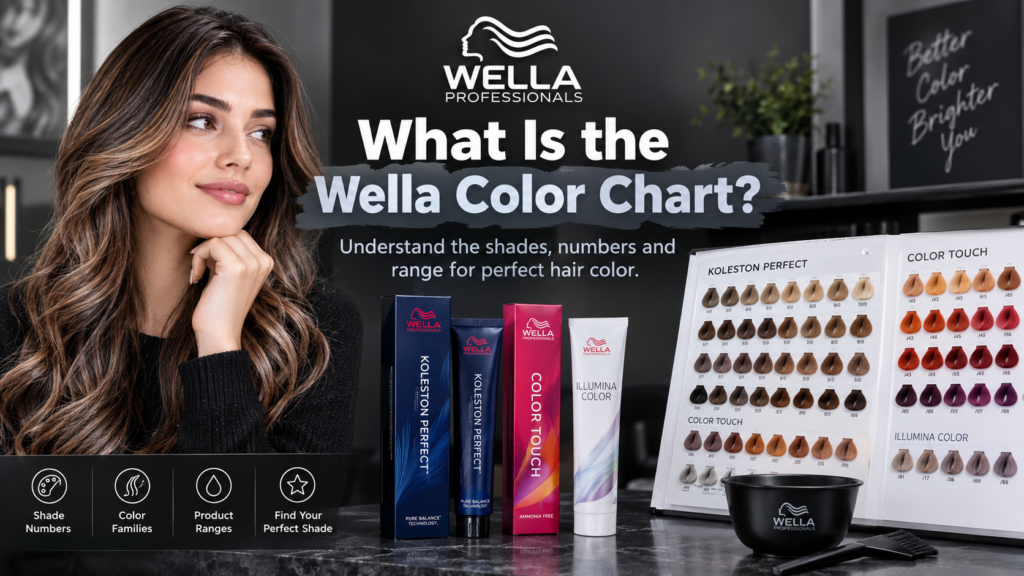
The Wella color chart is a reference system professional colorists use to identify hair color shades by level (depth) and tone (reflect). Every Wella shade is written as a code for example, 7/1 where the first number shows how light or dark the color is, and the number after the slash shows its underlying tone.
This two-part logic is what makes Wella’s system so efficient compared to brands that rely on descriptive shade names alone. A name like “Caramel Blonde” can mean different things depending on who’s reading it, but a code like 8/34 tells a trained colorist exactly what pigments are involved and what result to expect.
Wella uses this same core numbering logic across most of its professional lines, including:
- Koleston Perfect permanent, full-coverage color
- Koleston Perfect ME+ permanent color with allergy-conscious, low-ammonia technology
- Color Touch demi-permanent, ammonia-free color
- Illumina Color glossy-finish permanent color
- Color Fresh gentle, semi-permanent color
Understanding one chart essentially gives you a working knowledge of them all. Once you’re comfortable reading level and reflect numbers, switching between these product lines becomes far less intimidating, even if each one serves a different purpose in the salon.
How the Wella Numbering System Works
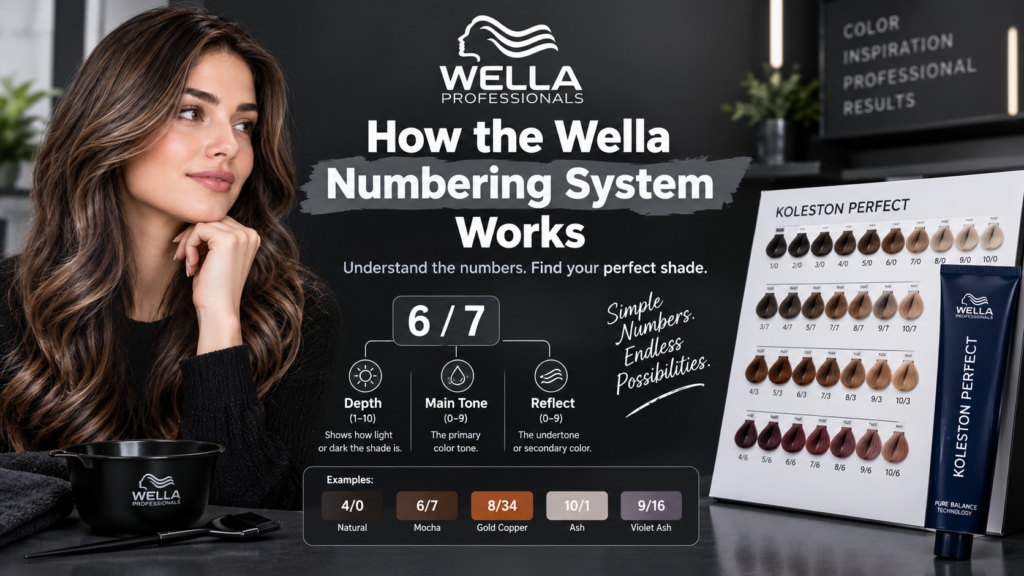
Wella’s shade codes follow a consistent structure: Level / Primary Reflect (Secondary Reflect)
The number before the slash = Level (depth of color), from 1 (black) to 12 (lightest blonde/high-lift). The number after the slash = Reflect (tone/undertone). Together, these two values form a complete description of the shade, and most formulas will also involve a developer strength chosen separately based on the desired lift.
It helps to think of level as the “how light or dark” and reflect as the “what color family.” A colorist reading 6/43, for instance, immediately knows they’re working with a dark blonde base carrying warm copper and gold undertones, without needing to check a swatch first.
Reflect (Tone) Numbers Explained
| Code | Tone |
| /0 | Natural |
| /1 | Ash |
| /2 | Matte/Green |
| /3 | Gold |
| /4 | Copper/Red-Orange |
| /5 | Mahogany/Red-Violet |
| /6 | Violet |
| /7 | Brown |
| /8 | Pearl/Silver |
| /9 | Slate/Cendré |
So a shade like 6/43 means Level 6 (dark blonde) with a primary copper reflect and secondary gold reflect. Reading codes this way lets you predict the outcome before ever opening the tube. It also helps when correcting unwanted tones if hair is pulling too warm, a colorist can select an ash or matte reflect to neutralize it before the next application.
Wella Level Chart: Levels 112 Explained
Here’s the complete depth chart, from darkest to lightest:
| Level | Shade Description |
| 1 | Black |
| 2 | Very dark brown |
| 3 | Dark brown |
| 4 | Medium brown |
| 5 | Light brown |
| 6 | Dark blonde |
| 7 | Medium blonde |
| 8 | Light blonde |
| 9 | Very light blonde |
| 10 | Extra light blonde |
| 12 | High-lift/special blonde |
Levels 11 typically don’t appear in most Wella lines; the system jumps from 10 to 12 for high-lift shades, which require more developer volume to achieve maximum lift.
Knowing where a client’s natural hair sits on this scale is just as important as knowing the target shade. A colorist comparing a client’s natural level 4 to a desired level 8 result immediately understands they need several levels of lift, which affects both developer choice and processing time.
Koleston Perfect Color Chart: Full Permanent Range
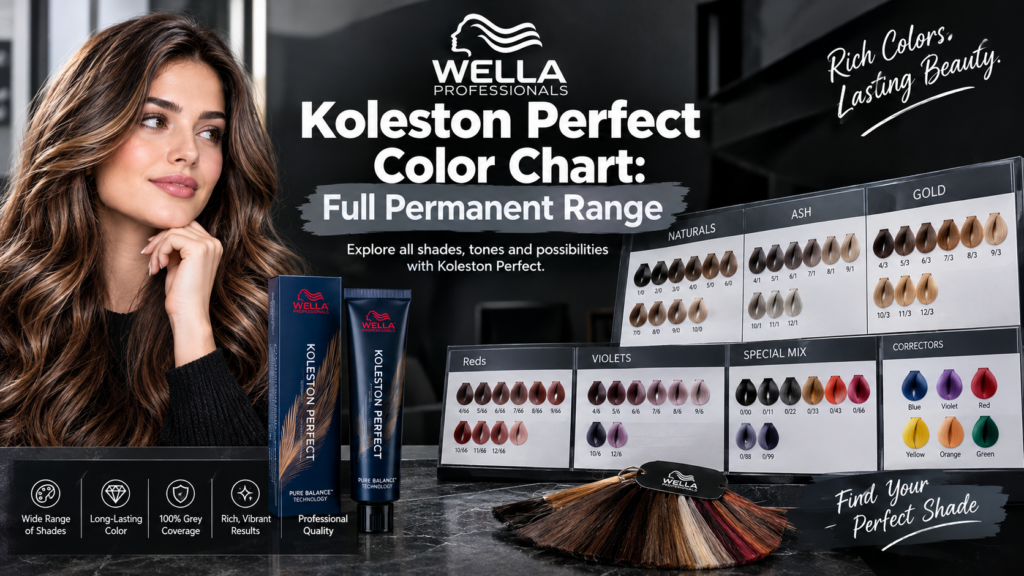
Koleston Perfect is Wella’s flagship permanent hair color, built for long-lasting, true-to-tone results with up to 100% gray coverage. The current range spans over 170 shades, formulated with Ultra Precision Technology and built-in bond protection for healthier-looking color.
This breadth of shades is part of why Koleston Perfect remains a salon staple worldwide. It gives colorists enough flexibility to formulate everything from subtle root touch-ups to dramatic full-head transformations, all within a single consistent system.
Koleston Perfect Shade Families
- Pure Naturals: true-to-level natural shades with no added warmth
- Rich Naturals: natural shades with subtle warmth for fuller-looking color
- Deep Browns: rich, chocolate-toned brunette shades
- Vibrant Reds: copper, mahogany, and red-violet tones
- Special Blondes: high-lift shades for maximum brightness
Each family serves a distinct styling purpose. Pure Naturals are often chosen for clients who want minimal warmth and maximum gray blending, while Rich Naturals and Deep Browns suit those seeking dimension and depth in brunette tones.
Koleston Perfect Developer Guide
| Developer Strength | Volume | Use Case |
| 1.9% | 6 vol | Tone-on-tone, deposit only |
| 6% | 20 vol | 12 levels of lift, standard gray coverage |
| 9% | 30 vol | 23 levels of lift |
| 12% | 40 vol | Maximum lift with high-lift shades |
Mixing ratio: Standard Koleston Perfect mixes at 1:1 with Welloxon Perfect developer, while high-lift shades typically require a 1:2 ratio for adequate lift.
Choosing the correct developer strength matters as much as choosing the right shade code. Using too strong a developer on hair that only needs gray coverage can cause unnecessary lift and unpredictable tonal shifts, while too weak a developer on hair needing significant lightening will leave the result underdeveloped.
See More: Matrix SoColor Pre-Bonded Color Chart: Shades, Levels & Hair Color Guide (2026)
Color Touch Chart: Demi-Permanent Range
Color Touch is Wella’s ammonia-free, demi-permanent line. Rather than lifting natural hair, it deposits color only making it ideal for toning, refreshing faded color, or adding shine without altering hair’s underlying structure.
Because it doesn’t lift the hair’s natural pigment, Color Touch is often the safer choice for clients with already-processed or fragile hair. It’s also a popular option for colorists who want to test a tone before committing to a permanent formula.
Key facts about Color Touch:
- Ammonia-free formula, gentler on hair and scalp
- Mixes at a 1:2 ratio with Color Touch Emulsion
- Covers up to 5060% gray hair
- Lasts approximately 2028 washes
- Uses the same level/reflect numbering as Koleston Perfect
Because Color Touch shares Wella’s core numbering logic, a 7/1 in Color Touch produces a similar tonal result to a 7/1 in Koleston Perfect just without the lifting power or permanence. This consistency is exactly why learning one chart carries over so well into the rest of Wella’s catalog.
Koleston Perfect vs. Color Touch: Quick Comparison
| Feature | Koleston Perfect | Color Touch |
| Color type | Permanent | Demi-permanent |
| Ammonia | Contains ammonia | Ammonia-free |
| Gray coverage | Up to 100% | Up to 5060% |
| Lift capability | Yes, up to 5 levels | No lift, deposit only |
| Longevity | Permanent, grows out | 2028 washes |
| Best for | Full color changes, gray coverage | Toning, refreshing, shine |
This side by side view is often the fastest way for a colorist to decide which line fits a client’s needs. A client wanting complete gray coverage and a lasting change points toward Koleston Perfect, while someone simply wanting to refresh faded ends or add gloss is better served by Color Touch.
How to Read a Wella Shade Code (Step-by-Step)
- Identify the level number before the slash this tells you depth.
- Read the first reflected number after the slash; this is the dominant tone.
- Check for a second reflect number that modifies the primary tone.
- Match to developer strength based on desired lift and gray coverage.
- Confirm the product line (Koleston vs. Color Touch) since formulas differ even when codes match.
Working through these steps in order removes the guesswork from formulating. Even colorists who are new to Wella can build confidence quickly by practicing this sequence on a handful of common shade codes before working on live clients.
Matching Wella Shades to Other Brands
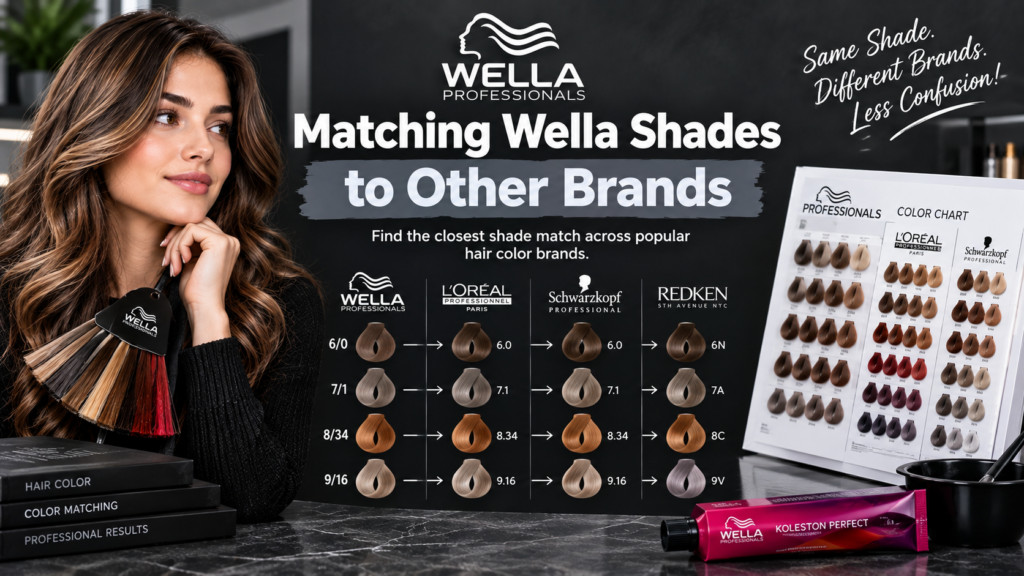
Because every brand uses its own numbering logic, direct conversions aren’t exact but level and reflect generally translate well. When converting:
- Match the level number first (depth should stay consistent across brands)
- Match the tone family second (ash, gold, copper, etc.)
- Always do a strand test, since base pigments vary by manufacturer
Several online hair color converter tools now let you input a Wella code and get the closest equivalent in brands like Redken, Matrix, or L’Oréal useful when a salon switches suppliers or a shade is temporarily out of stock. Even with these tools, remember that pigment concentration and base formulation differ between manufacturers, so a “closest match” is a starting point, not a guarantee.
Tips for Using the Wella Color Chart Accurately
- Always check your client’s natural level and percentage of gray before formulating
- Use a physical or digital swatch chart under proper lighting screen colors can be misleading
- Remember that porous or previously colored hair may process differently than the chart suggests
- Cross-reference the reflect number with desired end result, not just the shade name
- Keep the chart updated, since Wella periodically reformulates or discontinues specific shades
Beyond these basics, it’s worth doing a strand test whenever a client’s hair history is unclear, especially after box color or multiple previous salon services. A quick test saves time, protects hair integrity, and avoids costly correction appointments later.
Frequently Asked Questions
What does the number after the slash mean in Wella color codes?
It represents the reflect, or tone, of the shade such as ash, gold, or copper while the number before the slash indicates the level, or depth.
Is Koleston Perfect permanent or demi-permanent?
Koleston Perfect is a permanent hair color that lifts natural hair and offers up to 100% gray coverage.
Does Color Touch cover gray hair completely?
No, Color Touch typically covers up to 5060% gray and is best for toning or refreshing rather than full gray coverage.
What developer should I use with Koleston Perfect?
Use 6% for standard gray coverage and mild lift, 9% for 23 levels of lift, and 12% for maximum lift with high-lift shades.
Can I mix Color Touch with Koleston Perfect?
No, each line has its own compatible developer or emulsion, and the two should not be combined for processing.
How long does Color Touch color last?
Color Touch typically lasts 20 to 28 shampoos before fading, since it’s a demi-permanent, deposit-only color.
Conclusion
The Wella color chart isn’t as complicated as it first appears once you understand the level and reflect system behind it. Koleston Perfect delivers permanent, full coverage results, while Color Touch offers a gentler, deposit-only alternative for toning and refreshing.
Learning to read shade codes level first, reflect second gives you the confidence to formulate accurately, communicate clearly with clients, and get consistent, predictable color results every time. This same logic carries across Wella’s other lines, making the whole system easier to master.
With practice, checking a code like 7/43 or 9/16 becomes second nature rather than a lookup task. That familiarity is what separates a colorist who’s simply following instructions from one who truly understands the craft.





2 thoughts on “Wella Color Chart 2026: Koleston Perfect, Color Touch & Complete Range Guide”