
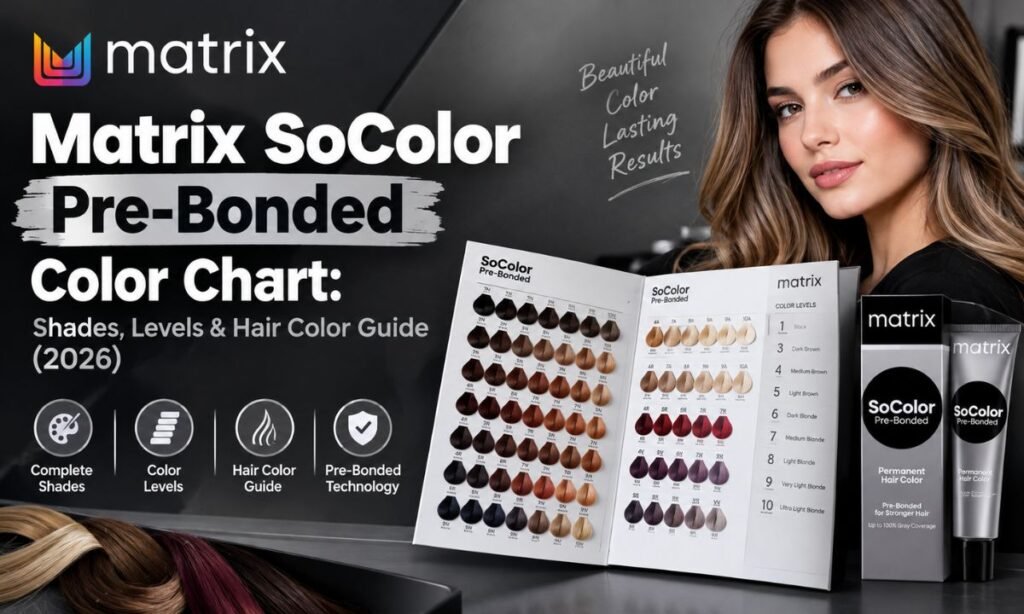
Picking the right shade from the Matrix SoColor Pre-Bonded line can feel overwhelming when you’re staring at a wall of codes like 6NA, 7CG, or 508W. Each one means something specific, and once you understand the system, choosing a formula becomes second nature.
This guide breaks down every level of the Matrix SoColor Pre-Bonded color chart, explains the numbering system, and shows you how these shades compare to other professional brands. Whether you’re behind the chair every day or coloring your own hair at home, this breakdown will help you formulate with confidence.
We’ll also walk through developer choices, gray coverage strategies, and how to match undertones to skin tone, so you’re not just memorizing codes but actually understanding why each shade behaves the way it does.
What Is Matrix SoColor Pre-Bonded?
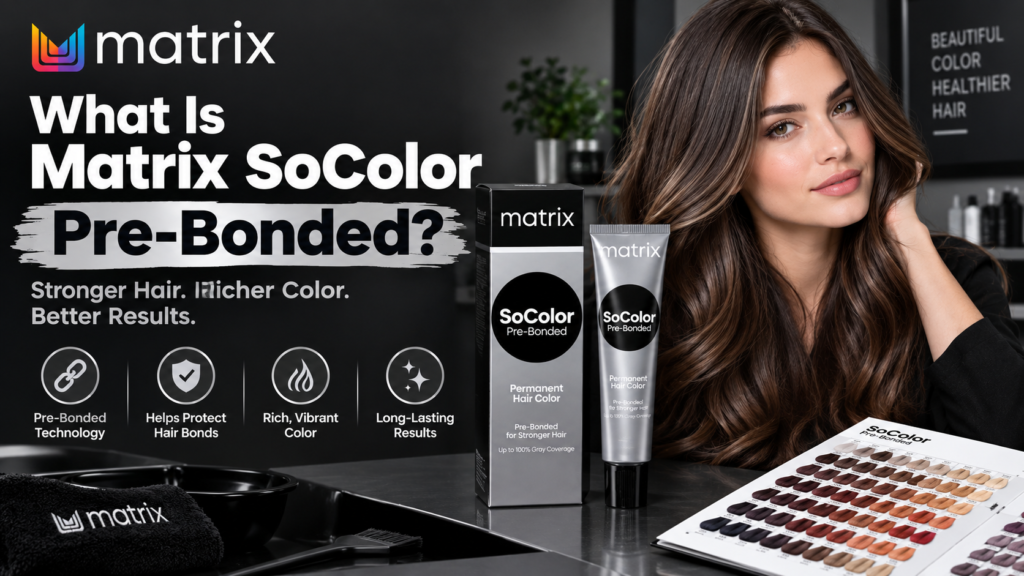
Matrix SoColor Pre-Bonded is a permanent, tube crème hair color built on Pre-Bonded technology, which works during the coloring process to protect the internal hair structure while pigment is deposited. Rather than repairing damage after the fact, it works proactively while color is being processed.
It’s one of the most widely used professional lines in North American salons because of its consistent, true-to-tone results. Colorists trust it because the outcome on the head closely matches what’s shown on the swatch chart.
The line covers gray hair fully, lifts natural pigment, and deposits tone in a single step. This all in one function is a major reason it’s a staple in salon color bars, since it saves time without sacrificing coverage or shine.
It’s formulated to work across every level and undertone, which is why colorists rely on it for both natural-looking results and bold fashion tones. From subtle gray blending to vivid red transformations, the line flexes to fit almost any client request.
How the Matrix SoColor Numbering System Works
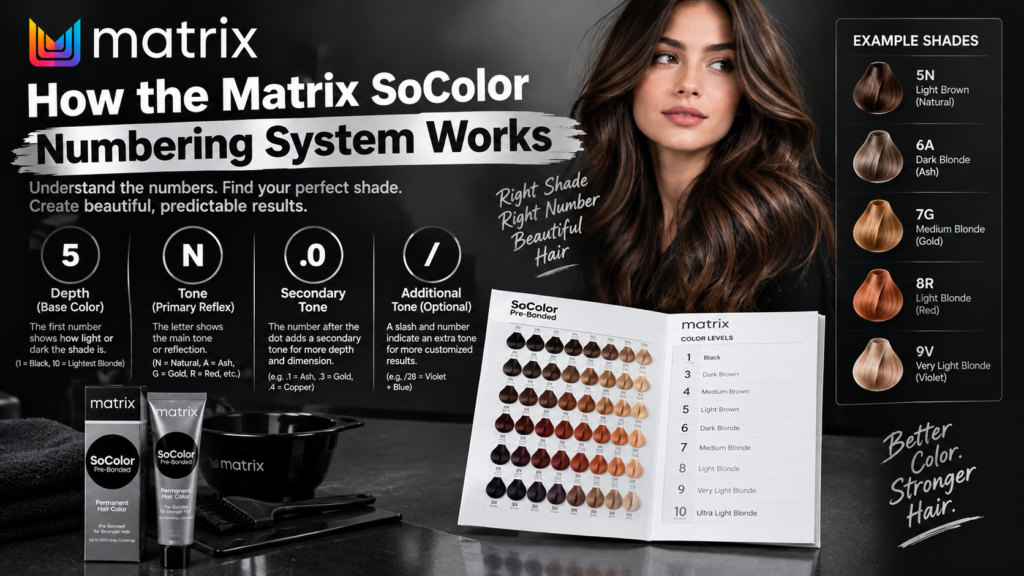
Every shade name follows a simple number + letter structure. The number tells you the depth (how light or dark), and the letter tells you the reflect (the underlying tone). Once this clicks, reading any shade code becomes intuitive.
For example: 7A means level 7 (dark blonde) with an ash reflect. The “7” tells you where it sits on the depth scale, while the “A” tells you it will neutralize warmth rather than add it.
| Letter Code | Reflect Meaning |
| N | Neutral |
| A | Ash |
| G | Gold |
| M | Mocha |
| P | Pearl |
| W | Warm |
| V | Violet |
| R | Red |
| C | Copper |
| B | Brown |
| J | Jade |
Reflects can also combine, such as RC (red copper), CG (copper gold), or NA (neutral ash). Combined codes give colorists more precision, letting them dial in a specific warmth level rather than settling for a single-tone approximation.
Matrix doesn’t use a standalone “pure copper” ; it always appears blended with another tone. This is intentional, since pure copper alone can look overly brassy or flat without a secondary tone to soften it.
Shades numbered with a “5” prefix, like 505N or 506NA, belong to the Extra Coverage sub-line, formulated for stubborn or resistant gray hair. These formulas carry a denser pigment load specifically designed to grab onto coarse, resistant gray strands.
See More: Goldwell Color Chart Explained
Matrix SoColor Pre-Bonded Levels Chart
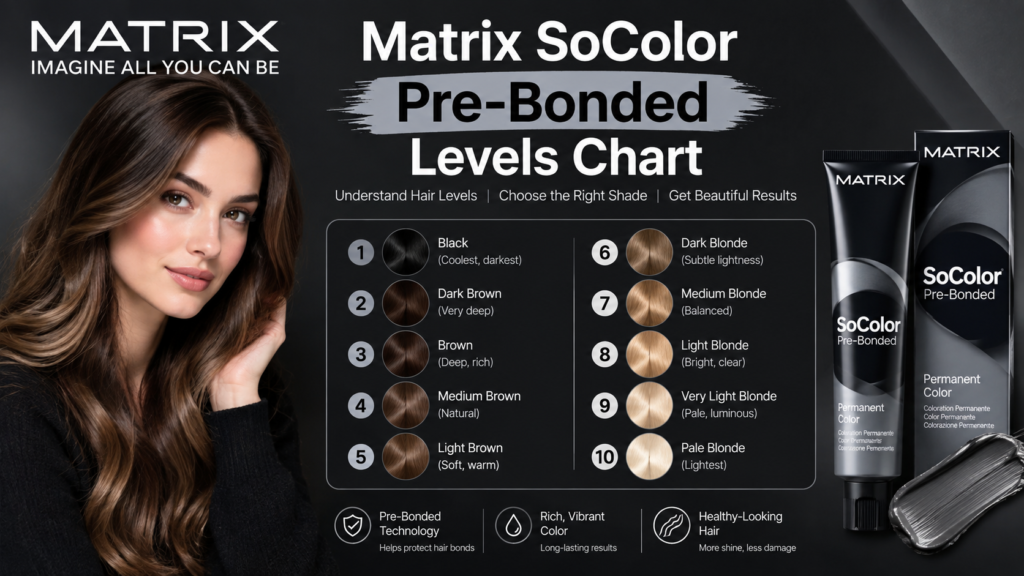
The level system runs from 1 (black) to 11 (lightest blonde+). Here’s what each level represents, along with the depth name and some of the most commonly used shade codes at each level.
| Level | Shade Depth | Popular Shade Names | Example Shades |
| Level 1 | Black | Black | 1N |
| Level 2 | Very dark brown | Very Dark Brown | 2N |
| Level 3 | Dark brown | Darkest Brown, Dark Red-Violet Brown | 3N, 3AA, 3RR, 3VR |
| Level 4 | Medium brown | Medium Brown, Medium Ash Brown, Medium Mocha Brown | 4N, 4A, 4AA, 4M |
| Level 5 | Light brown | Light Brown, Light Golden Brown, Light Red Copper Brown | 5N, 5G, 5RC, 5W |
| Level 6 | Dark blonde | Dark Blonde, Dark Neutral Ash Blonde, Dark Red Brown | 6N, 6NA, 6RB, 6M |
| Level 7 | Medium blonde | Medium Blonde, Medium Ash Blonde, Medium Pearl Blonde | 7N, 7A, 7P, 7CG |
| Level 8 | Light blonde | Light Blonde, Light Ash Blonde, Light Warm Blonde | 8N, 8AA, 8W, 8CC |
| Level 9 | Very light blonde | Very Light Blonde, Very Light Ash Blonde, Very Light Gold Blonde | 9N, 9A, 9P, 9G |
| Level 10 | Extra light blonde | Extra Light Blonde, Extra Light Ash Violet | 10N, 10AV |
| Level 11 | Lightest blonde+ | Ultra Light Blonde, Ultra Light Pearl Blonde | 11N, 11A, 11P |
A few things worth noting as you move through the chart:
Levels 1–2 contain only neutral options, since black and near-black tones rarely need a reflection. There’s simply not enough underlying warmth at these depths to require correction.
Levels 3–7 have the widest shade range, covering nearly every reflected family. This is the depth range most clients fall into naturally, which is why formulators built in so much variety here.
Levels 9–11 are lightest and mostly limited to neutral, ash, pearl, and gold reflections, since fewer people lift hair this high while still needing warmth control. At these levels, the priority shifts toward controlling brassiness rather than adding richness.
Popular Shades by Reflect Family
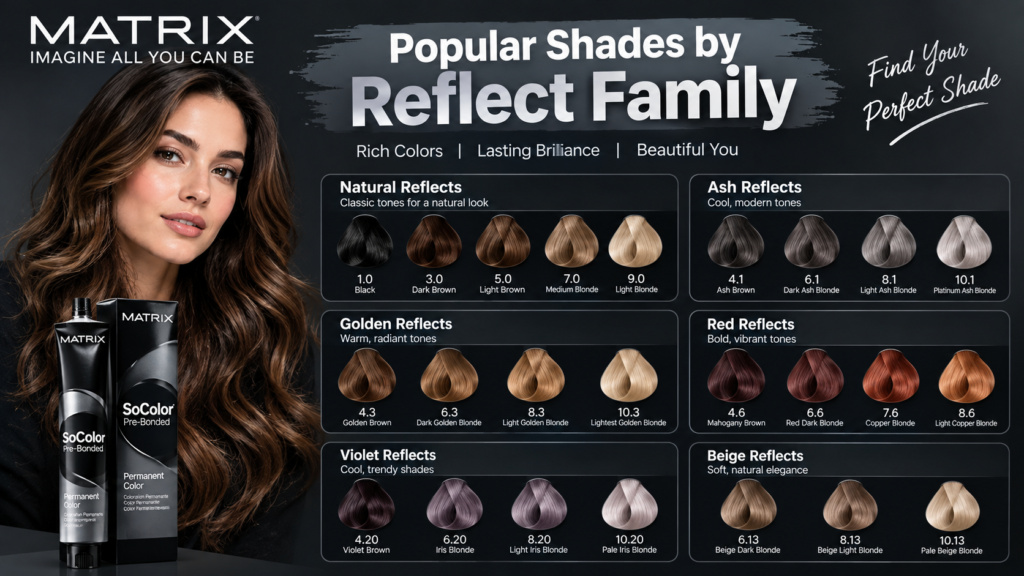
Naturals (N): Balanced, true-to-level results with no strong warm or cool cast — good for beginners and gray blending. They’re often the safest starting point when a colorist is unsure which direction a client wants to go.
Ash (A): Neutralizes warmth, ideal for cool, muted brunettes and blondes. Ash shades are frequently reached for when a client wants to counteract natural brassiness left over from previous color.
Gold (G): Adds warmth and dimension, common for natural-looking sun-kissed tones. This reflection works especially well on clients wanting a soft, believable warmth rather than an obvious tint.
Copper/Red (C, R): Vibrant, high-impact reflects for bold color changes. These shades are popular for statement looks and tend to fade with a warm, coppery undertone rather than turning dull.
Mocha (M): A soft, cool-neutral brown tone popular for lived-in brunette looks. It sits between true neutral and ash, giving depth without looking flat or overly cool.
Pearl (P): Cool, iridescent finish often used on lighter blondes. Pearl reflects and adds a soft shimmer that keeps pale blondes from looking dull or yellow.
Choosing the Right Developer for Matrix SoColor
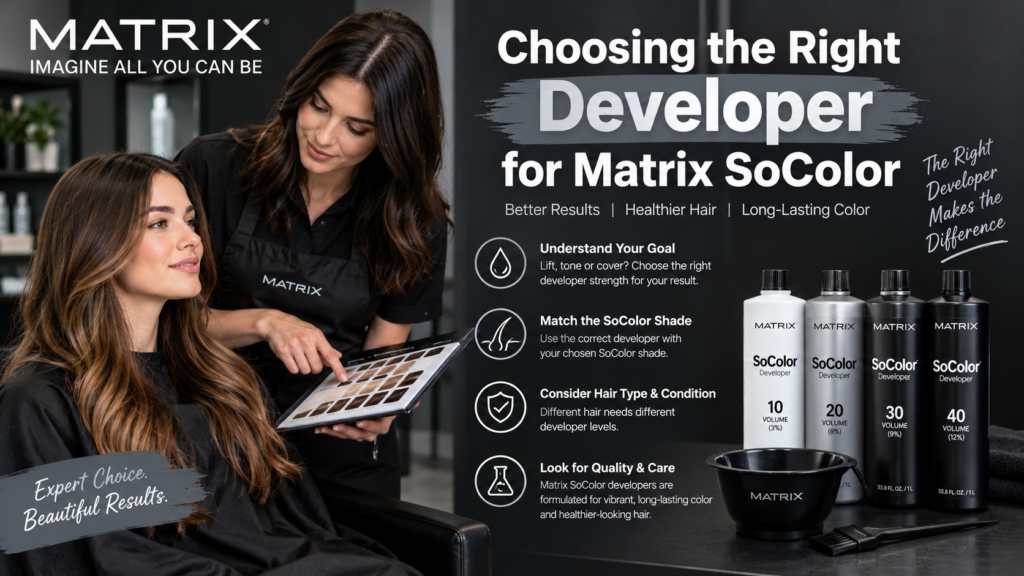
The developer volume you choose determines how much lift and gray coverage you’ll get. Choosing the wrong volume is one of the most common reasons a formula doesn’t turn out as expected.
As a general guide:
10 Volume (3%) – Tone-on-tone deposit, no lift. Best used when a client wants to refresh color or shift tone without changing depth.
20 Volume (6%) – 1–2 levels of lift plus gray coverage. This is the most commonly used volume for standard gray-covering applications.
30 Volume (9%) – 2–3 levels of lift. Useful when a client wants a noticeably lighter result without going through a separate lightening step.
40 Volume (12%) – Maximum lift, typically for pre-lightened or high-lift formulas. This strength should be used carefully, since it carries a higher risk of scalp sensitivity and hair damage.
Always mix with Matrix Cream Developer at the ratio recommended on the shade’s packaging, since ratios can shift slightly between the standard line and the Extra Coverage or Ultra Blonde collections. Skipping this step and assuming a universal ratio is a common mistake that leads to inconsistent results.
Gray Coverage with Matrix SoColor Pre-Bonded
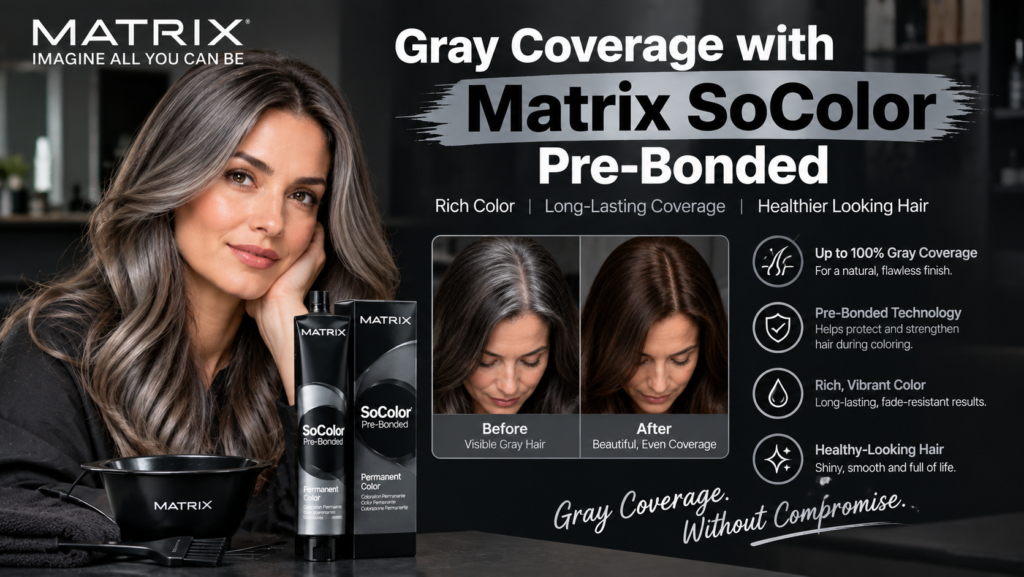
Matrix SoColor Pre-Bonded is formulated for 100% gray coverage. This makes it a reliable choice for clients who want their gray fully concealed rather than just blended.
For resistant or wiry gray hair, many colorists mix in a neutral (N) shade at a 50/50 ratio with the fashion shade to boost coverage without dulling the tone. This technique keeps the desired reflect intact while still giving stubborn strands the pigment density they need.
Fine or scattered gray usually blends well with pure fashion shades on their own. In these cases, adding extra neutral isn’t necessary and can sometimes flatten the intended tone unnecessarily.
Testing a small section first is always a smart move when a client mentions their gray has been resistant to color in the past. It saves time and prevents an uneven, patchy result across the whole head.
Matrix SoColor Pre-Bonded vs Other Brands
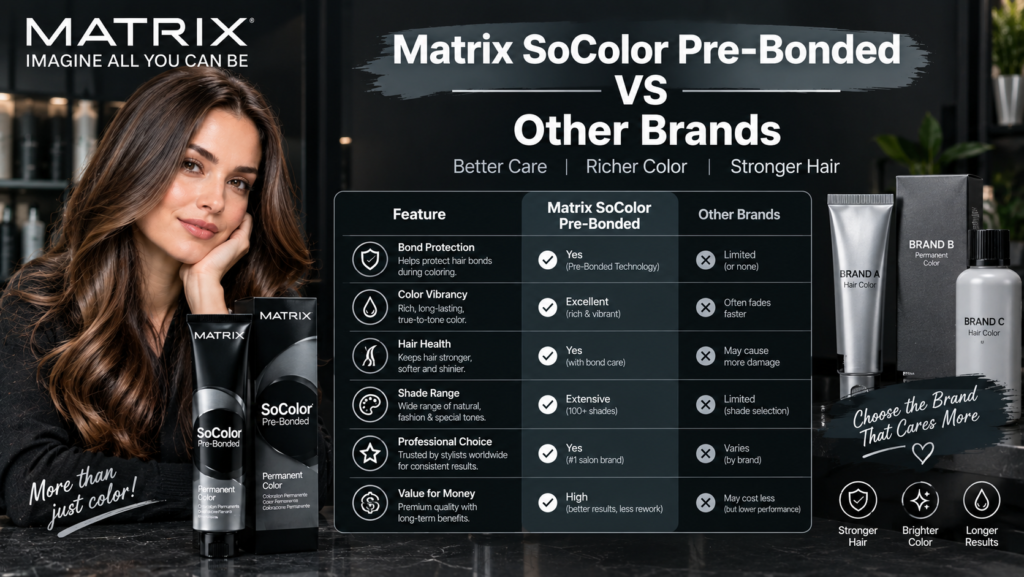
If you’re used to a different professional line, here’s how Matrix SoColor Pre-Bonded levels roughly compare to other popular systems. These are approximate matches every brand uses its own pigment base, so a strand test is always recommended before switching.
| SoColor Pre-Bonded | Wella Koleston Perfect | Schwarzkopf Igora Royal | L’Oréal Majirel |
| 1N Black | 2/0 | 1-0 | 1 |
| 3N Darkest Brown | 3/0 | 3-0 | 3 |
| 5N Medium Brown | 5/0 | 5-0 | 5 |
| 7N Dark Blonde | 7/0 | 7-0 | 7 |
| 9N Light Blonde | 9/0 | 9-0 | 9 |
| 10N Extra Light Blonde | 10/0 | 10-0 | 10 |
One important note: Matrix’s level scale sits roughly one level above the European numbering used by some brands, meaning a Matrix level 7 can align closer to a European level 6. This shift can throw off colorists who are used to reading charts from a different system.
This is a common source of confusion when converting formulas between brands, so always cross-check with a proper conversion chart rather than assuming a direct number match. Relying purely on memory when switching brands is a frequent cause of formulation mistakes.
Even with a conversion chart in hand, pigment bases differ enough between manufacturers that results can still vary slightly. A patch test remains the safest way to confirm a match before committing to a full head application.
Tips for Choosing Your Matrix SoColor Shade
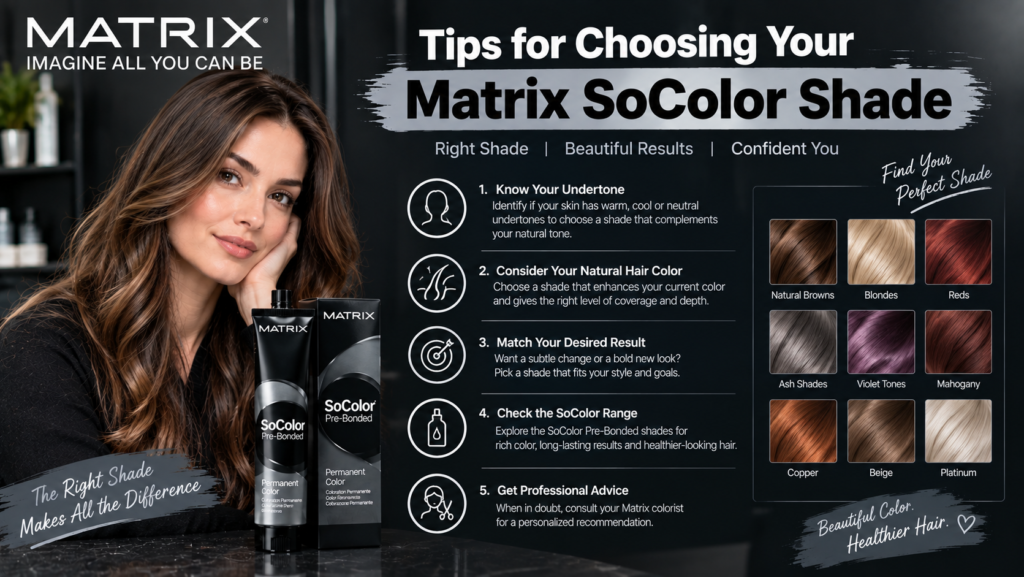
Knowing your starting level before picking a target shade lift capability depends on the gap between natural and desired level. Skipping this step often leads to disappointment when the final color doesn’t lift as far as expected.
Match undertones carefully. Warm skin tones often pair well with gold or copper reflects, while cool skin tones lean toward ash or pearl. Getting this pairing right makes the finished color look intentional rather than accidental.
Do a strand test for any new formula, especially when converting from another brand’s shade chart. This small extra step can save an entire service from going wrong.
Use Extra Coverage shades (the 500-series) for clients with 50% or more gray hair. These formulas are built specifically to handle dense, resistant gray that standard shades might struggle to cover fully.
Keep a shade record for repeat clients so future color-matching stays consistent. A simple formula card prevents guesswork and keeps results predictable visit after visit.
Frequently Asked Questions
What does the letter after the number mean in Matrix SoColor?
The number shows the level (depth), and the letter shows the reflect, such as N for neutral, A for ash, or G for gold.
What developer should I use with Matrix SoColor?
Use 10 volume for tone-on-tone, 20 volume for 1–2 levels of lift, 30 volume for 2–3 levels, and 40 volume for maximum lift.
Does Matrix SoColor Pre-Bonded cover gray hair?
Yes, it offers full gray coverage, and mixing in a neutral shade helps with resistant gray.
What is Pre-Bonded technology?
It’s a care complex built into the color that protects hair bonds during the chemical process rather than after it.
How many shades are in the Matrix SoColor Pre-Bonded line?
The full permanent collection spans over 100 shades across 11 levels, plus the Extra Coverage and Ultra Blonde sub-lines.
Can I convert a Matrix shade to another brand?
Yes, using level-and-reflect matching, though a strand test is recommended since every brand’s pigment base differs slightly.
Conclusion
The Matrix SoColor Pre-Bonded color chart looks complex at first glance, but it’s really just a level-and-reflect code system once you break it down. Understanding what each number and letter represents makes the whole line far less intimidating.
Combined with the right developer choice and a solid grasp of gray coverage techniques, formulating becomes much more predictable. You’ll spend less time guessing and more time delivering the exact tone your client asked for.
Keep this guide handy as a quick reference the next time you’re formulating a color, whether that’s a rich natural brunette, a cool lifted blonde, or a bold copper transformation.





1 thought on “Matrix SoColor Pre-Bonded Color Chart: Shades, Levels & Hair Color Guide (2026)”